【Indonesian CSOs’ Joint Statement】Calling on Japan to End Any Finance for Gas Projects under the AZEC Scheme in Celukan Bawang, Bali, Indonesia
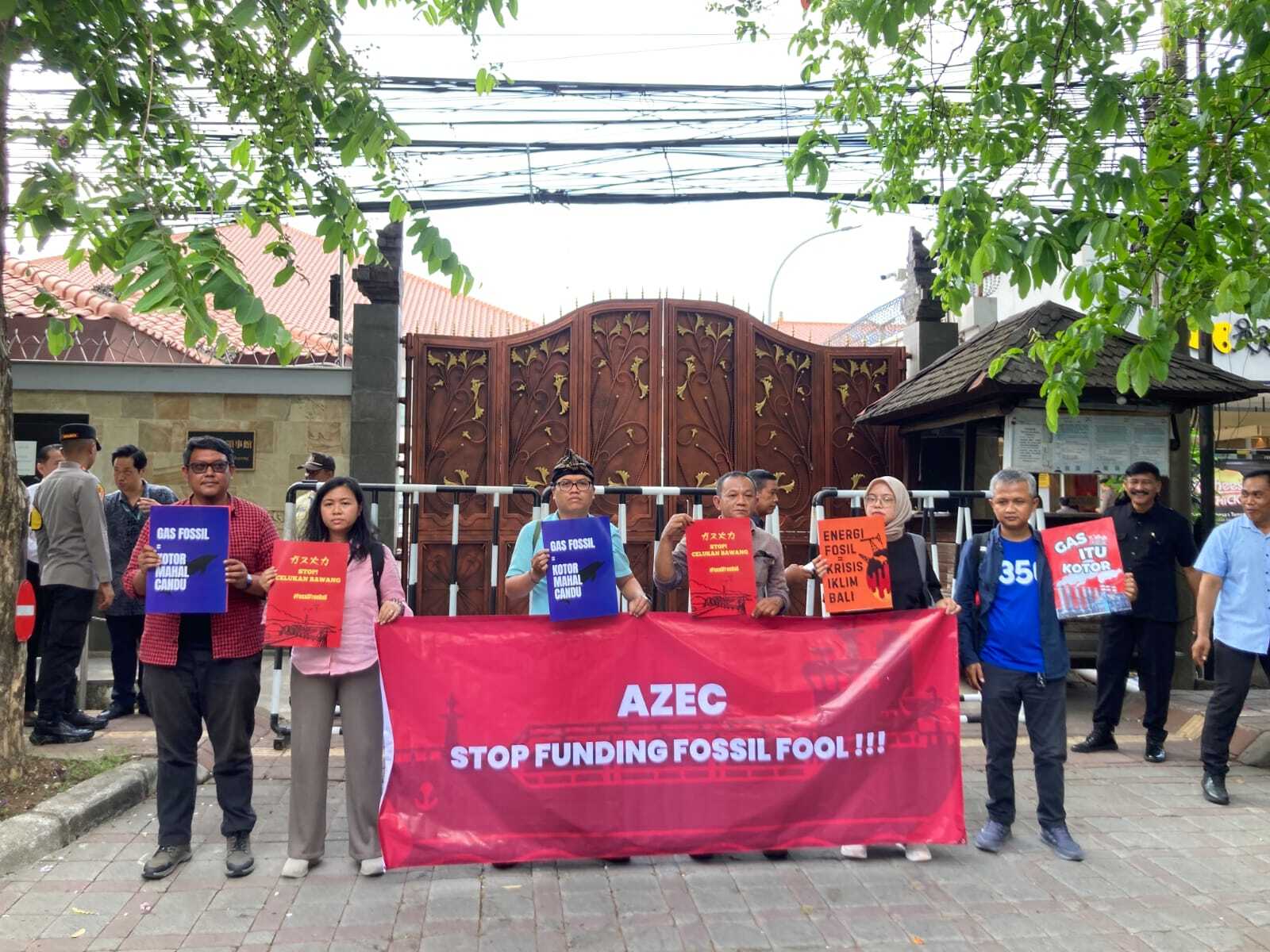
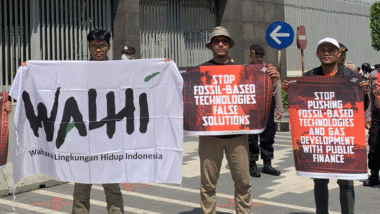
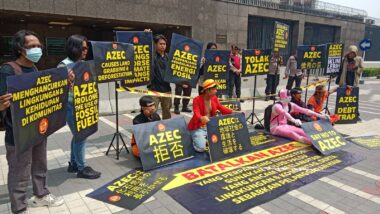
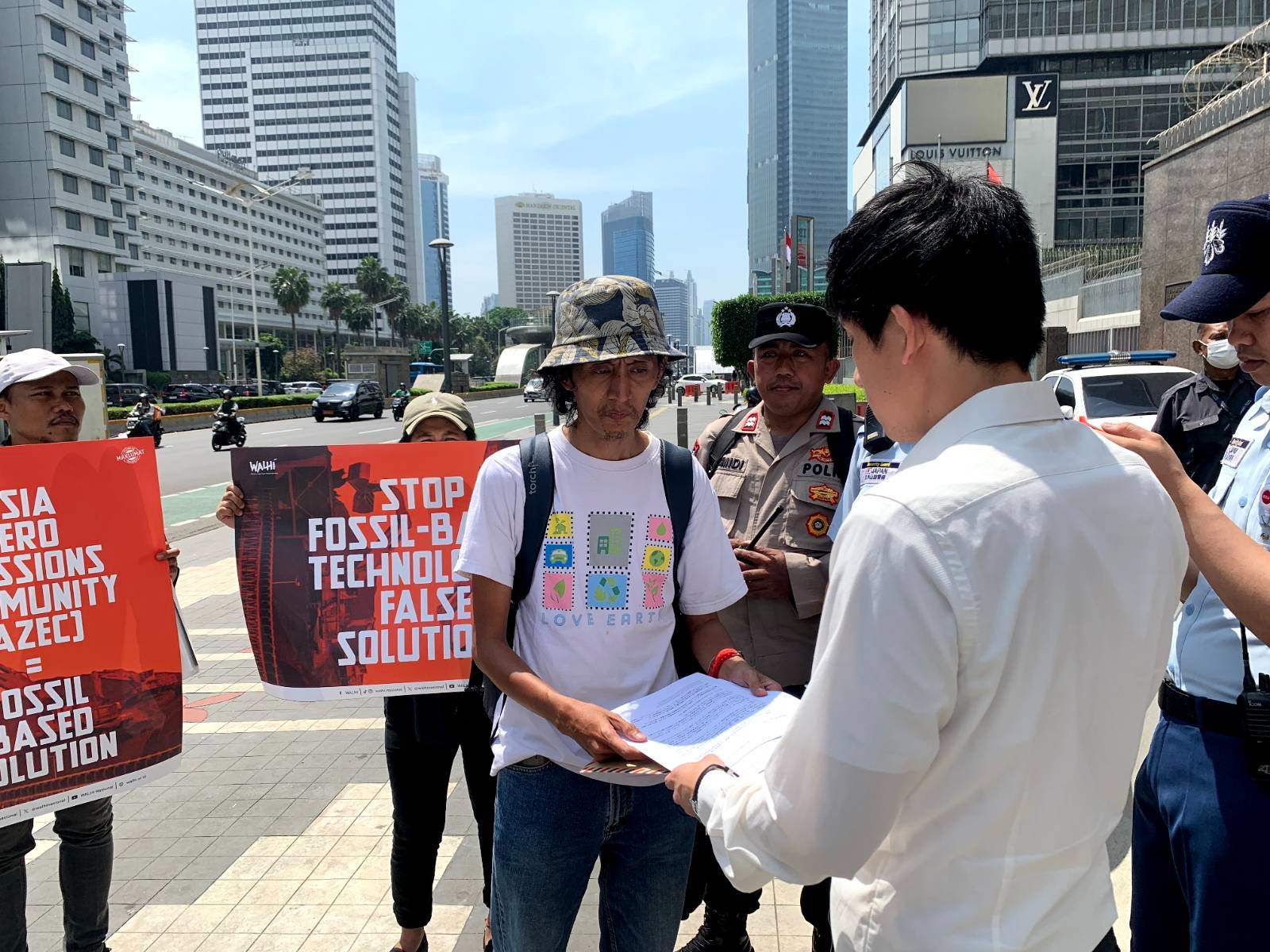
On November 16, 2026—just one day ahead of the Asia Zero Emission Community (AZEC) Leaders’ Meeting in the Philippines—local Balinese and national civil society organizations (CSOs) staged a protest outside the Consulate-General of Japan in Denpasar, Bali, Indonesia. During the action, they handed over a joint statement (signed by 29 organizations) to consulate staff, urging both the Japanese public and private sectors not to provide any financing for gas-fired power plant projects and related infrastructure.
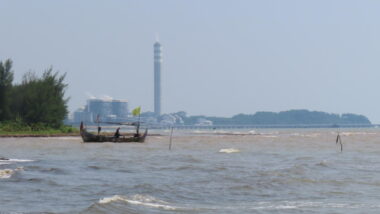
In northern Bali, concerns are mounting over plans by Electric Power Development Co., Ltd. (J-POWER) to construct a gas-fired power plant in Celukan Bawang, following the announcement of a Joint Development Agreement for a gas-fired combined cycle power plant at the AZEC Ministerial Meeting in October 2025. The joint statement points out that local communities have not been provided with sufficient information regarding the project’s adverse impacts, and that the project is moving forward without the communities ever being asked whether they want it. It also raises the alarm over threats to local fishing grounds and marine ecosystems.
Furthermore, the statement criticizes AZEC as “greenwashing"—claiming to promote “zero emissions" while in reality locking the Asian region into greenhouse gas (GHG) emissions for decades to come through gas and other fossil fuel projects.
Below is the joint statement by Indonesian civil society organizations (CSOs).
16 November 2026
JOINT STATEMENT:CALLING ON JAPAN TO END ANY FINANCE FOR GAS PROJECTS UNDER THE AZEC SCHEME IN CELUKAN BAWANG, BALI, INDONESIA
We, the undersigned local, national and international civil society organizations, urge the Government of Japan and its public finance institutions to stop using the Asia Zero Emission Community (AZEC) to fund and promote gas projects in Indonesia, including in Bali, and to reject any support for the proposed combined-cycle gas power plant (PLTGU) at Celukan Bawang, Buleleng, Bali.
We deliver this letter by hand in Bali, where new gas projects are being planned along the coast, because what AZEC finances does not match what it claims to be. A scheme that calls itself a “zero emission community” cannot keep building the gas and LNG infrastructure that locks in decades of emissions. In Indonesia, Japanese public and private investors have planned and financed gas and LNG projects for years. In Bali, the same logic is now arriving at the shore of a fishing village that has never been asked whether they want it.
PT PLTG Celukan Bawang and Electric Power Development Co., Ltd. (J-POWER) have signed a joint development agreement for a gas and steam power plant at Celukan Bawang under the AZEC scheme in 2025. We call on Japan to immediately stop this project and to stop financing new gas and LNG infrastructure in Indonesia and across Asia under AZEC.
1. Gas and LNG Expansion in Bali, Indonesia
Bali’s electricity plan (RUPTL 2025–2034) and spatial plan (RTRW 2023–2043) make room for new gas projects, yet North Bali’s coast is also valued for natural and marine tourism. Celukan Bawang is one of the coastal villages in Buleleng Regency, North Bali, with at least 292 fishers in six fishing groups (KUB) depending on its waters. The proposed plant would sit right next to the existing coal-fired power plant (PLTU) and this site lies about 7–14 km from a marine conservation area designated by Decree of the Minister of Marine Affairs and Fisheries Number 122 of 2023. Buleleng waters are also an Important Marine Mammal Area (IMMA), which has to be delineated and managed for conservations. Rhizoma Indonesia’s preliminary study, Captu1ring Celukan Bawang (Pt. 1): Living Spaces & “Plans” (September, 2026), has identified several potential impacts of this gas project concerning socio-economic, biodiversity, and climate.
2. Our Concerns
A zero-emission scheme should not lock in gas. Gas power plants and LNG terminals are built to run for decades. Each new one locks in fossil fuel use and methane leakage, making the rapid, just, and equitable transition to renewable energy hindered. Japan has been described as one of the world’s largest public financiers of overseas fossil fuel projects. Using a “zero-emission” label to continue that pattern is greenwashing.
Communities are excluded. AZEC agreements and the projects behind them are shaped among governments and companies, without meaningful public participation. At Celukan Bawang, residents say that the two consultation meetings were held in September–October 2025 for the project’s environmental study, carried out by PT Gajahmada Consultant for PT PLTG Celukan Bawang. Only village officials and fishing-group leaders were invited. The participants were told only that the gas plant would have no impact at all. One group leader described the meeting as a formality: three people were allowed to ask questions, and that was cut to two. The research also found that women have far less access to information and participation than men, and that 55% of fishers are undecided because no one has told them what the impacts could be.
Celukan Bawang’s fishing grounds and marine life are at risk. Rhizoma Indonesia’s spatial analysis, which models the plant’s likely design from secondary data, found that:
The assumed LNG shipping lane would cut across 44.24% of the fishers’ catchment area, risking conflict over sea space;
- The assumed LNG shipping lane would cut across 44.24% of the fishers’ catchment area, risking conflict over sea space;
- 18 of 123 dolphin sighting points (14.6%) fall in the highest sensitivity class for increased ship traffic;
- Underwater noise from LNG tankers could exceed the 120 dB re 1 µPa (NOAA NMFS Guideline2) threshold for marine mammal disturbance at five dolphin sighting points;
- One coral site lies about 500 m from the assumed hot-water outfall, where a 1–2°C rise in temperature risks coral bleaching (NOAA Coral Reefs Watch Guideline3);
- Three coral sites, 600 m to 3 km from the assumed dredging point, could see suspended sediment above the 20 mg/L quality standard (Decree of the Minister of Environment Number 51 of 2004).
The safety and climate risks are serious. Rhizoma Indonesia’s modelling of a small fugitive gas leak shows a hazardous zone of about 255 m and a caution zone of about 775 m from the leak. Ten minutes of leakage at the modelled rate would release about 67.5 tonnes of methane, equal to about 5,569 tonnes of CO2. Applying international LNG safety distances, 24,530 residents and 525.57 hectares of settlement fall within 3,500 m of the planned facility. So do 96.55% dolphin sighting points and 74.29% of the fishing grounds. Under the siting principles of SIGTTO4, the international body for gas terminal operators, a site with this many people nearby should have been avoided at the planning stage.
These findings come from preliminary modelling based on secondary data, because the project has not been built and its impact studies are not public. That is exactly the problem. The people who would bear the risk cannot judge it, and the companies and governments backing the plan have not shown them the evidence.
The plan falls short of international standards, such as the OECD Guidelines for Multinational Enterprises on Responsible Business Conduct. The Japanese government promotes multinational enterprises’ awareness and encourages effective implementation of the Guidelines. Thus, companies, such as J-POWER, must be required to engage meaningfully with affected stakeholders, respect human rights, and prevent environmental harm and disclose environmental impacts.
3. Our Demands
We call on the Government of Japan and other Japanese public and private entities involved to:
- Exclude any fossil fuel-based technologies from AZEC. Stop using AZEC to channel public money into new gas, LNG, co-firing with biomass, ammonia and hydrogen, and other fossil fuel projects in Indonesia and across Asia, and disclose the full list of AZEC projects, their finance and their assessments.
- End public finance for new gas and LNG in Indonesia, including Bali. Provide no financing, insurance, guarantees, technical assistance or other public support for new gas and LNG projects.
- Stop the Celukan Bawang gas power plant. Reject any support for the project. J-POWER should withdraw from its joint development agreement with PT PLTG Celukan Bawang.
- Respect the community’s right to decide. Ensure that the people of Celukan Bawang and other affected communities, give or withhold their Free, Prior and Informed Consent (FPIC), through a process that is open, inclusive and independent of the project developer.
- Disclose every information related to the environment, social, and climate impacts. Publish all environmental and social studies, the Environmental Impact Assessment (EIA/AMDAL), risk and safety assessments, and the methane and climate analysis for these projects, in Indonesian and in a form with which communities can access and understand.
- Open AZEC to the people it affects. Ensure affected communities and civil society from Indonesia and across Asia to meaningfully participate in AZEC decision-making.
- Support for a rapid, just, and equitable transition. Redirect public finance, in a grant manner, to community-led renewable energy and energy efficiency that people in host communities need, and adhere to the international standards and agreements, including the Paris Agreement and the OECD Guidelines, in full.
We ask the Government of Japan to respond publicly to this letter.
4. Closing
Japan says AZEC is about zero emissions. The test is whether it will stop financing gas and LNG in Bali, and whether it will listen to the people who live beside these projects. For Celukan Bawang the question is concrete. Their waters, their catch and their homes are at stake in a plan they were never asked about. Celukan Bawang belongs to the communities of Celukan Bawang. We ask Japan to stand with them.
Sincerely,
The undersigned organizations
Signatories:
- LBH Bali
- WALHI Bali
- Rhizoma Indonesia
- 350 Indonesia
- Indonesian Center for Environmental Law
- Trend Asia
- WALHI Jawa Tengah
- Indonesia Climate Justice Literacy
- Natural Resources and Climate Justice Program, Tifa Foundation
- LaporIklim
- #BersihkanIndonesia
- Koalisi Rakyat untuk Keadilan Perikanan (KIARA)
- Eksekutif Nasional WALHI
- Jaringan Advokasi Tambang (JATAM)
- APEL Green Aceh
- Kanopi Hijau Indonesia
- Srikandi Lestari
- Yayasan Keadilan Iklim
- Climate Ranger Sumut
- Perkumpulan Pembela Lingkungan Hidup
- Pasraman Air
- Yayasan Indonesia CERAH
- Aksi Ekologi dan Emansipasi Rakyat (AEER)
- WALHI Jawa Timur
- Greenpeace Indonesia
- Center of Economic and Law Studies (CELIOS)
- WALHI Sulawesi Selatan
- Indonesian Legal Aid Foundation – Pekanbaru Legal Aid
- WALHI Kalimantan Selatan
Contact:
Amanda Paramerta
Rhizoma Indonesia
TEL:+62 812 3709 6525
email:amandaparamerta@rhizomaindonesia.org
- Research by Rhizoma Indonesia (Capturing Celukan Bawang Pt. 1: Living Spaces & “Plans”)
↩︎ - NOAA National Marine Fisheries Service Guideline
↩︎ - NOAA Coral Reefs Watch Guideline ↩︎
- SIGTTO (https://www.sigtto.org)
↩︎