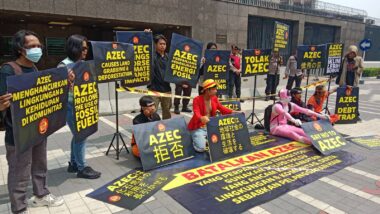
Indonesian Environmental Groups Submit Petitions to Japan’s Public and Private Sectors, Calling to Stop the Green Ammonia Initiative from Aceh (GAIA) Project
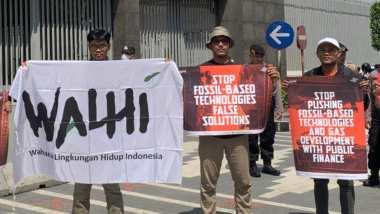
On December 19, 2025, Indonesian Forum for the Environment (WALHI/Friends of the Earth Indonesia) submitted letters to Toyo Engineering Corporation (TOYO), ITOCHU Corporation, and Japan Bank for International Cooperation (JBIC, wholly owned by the Japanese government), expressing its opposition to the planned Green Ammonia Initiative from Aceh (GAIA) Project in northern Sumatra and calling for the cancellation of the project and the suspension of any consideration of financing. In the letters, WALHI points out that the project, claimed to be a solution for energy transition, is in fact nothing more than a “false climate measure” that prolongs fossil fuel use, poses a serious threat to the safety of the environment and local communities, and violates residents’ rights to information and participation. It condemns the project as “greenwashing” that misleads the public.
Please see below for the full texts of the respective letters (the petition addressed to the companies and the protest letter addressed to JBIC).
Full Text of the Petition to PT Pupuk Indonesia, Toyo Engineering Corporation, and ITOCHU Corporation
>PDF is available here (Japanese translation)
*) This English version is an interpretation of the original Indonesian version. If there are any differences in words or sentences, please refer to the Indonesian version.
December 19, 2025
Mr. Rahmad Pribadi, President Director, PT Pupuk Indonesia
Mr. Eiji Hosoi, President & CEO, Toyo Engineering Corporation
Mr. Masahiro Okafuji, Chairman & Chief Executive Officer, ITOCHU Corporation
PETITION: Stop the Project Green Ammonia Initiative from Aceh (GAIA), which Extends Dependence on Fossil Energy, Employs False Solutions that Threaten Community and Environmental Safety, and Violates the Right to Information and Participation of Local Communities
The Indonesian Forum for the Environment (WALHI) submits this petition as a form of rejection of the Green Ammonia Initiative from Aceh (GAIA) Project. We demand that PT Pupuk Indonesia (Persero), together with its international partners ITOCHU Corporation and Toyo Engineering, immediately halt this project. The GAIA Project, which is promoted as an energy transition solution, in fact prolongs Indonesia’s dependence on fossil fuels, poses serious threats to the safety of local communities, damages the environment, and violates the people’s rights to information and participation guaranteed by law.
The involvement of ITOCHU and Toyo Engineering in the GAIA Project reinforces an initiative that is demonstrably still dependent on fossil energy. The claim that this project will produce green hydrogen cannot be substantiated, as the electricity used for the electrolysis process comes from the PLN Aceh grid, which to this day remains 98 percent fossil-fuel based. The Renewable Energy Certificate (REC) used as the basis for this claim is merely an administrative instrument that does not guarantee an actual supply of renewable energy. In addition, the existing ammonia plant continues to use grey hydrogen derived from fossil gas in its ammonia production process. Consequently, the product to be generated is merely hybrid ammonia, not the green ammonia as claimed. The involvement of these two Japanese companies, rather than being part of a just energy transition solution, instead contributes to greenwashing practices that mislead the public and contradict their global commitments to the Sustainable Development Goals (SDGs), the Paris Agreement, and Environmental, Social, and Governance (ESG) principles.
Moreover, the GAIA Project cannot be separated from PT Pupuk Iskandar Muda’s (PIM) poor track record regarding community safety. Between 2010 and 2025, there were nine recorded incidents of ammonia leakage that affected approximately 2,000 residents with serious health symptoms, ranging from shortness of breath, nausea, and fainting, to intensive hospital care. The Assessment Report on the Impacts of PT PIM’s Production in North Aceh and Lhokseumawe City prepared by WALHI Aceh reveals how the existing emergency system is severely inadequate: there are no evacuation procedures, the sirens used are confusing as they overlap with routine factory signals, and residents are forced to cope independently. Vulnerable groups such as children, the elderly, and pregnant women face greater health risks without adequate protection. The company’s Corporate Social Responsibility (CSR) programs have also proven ineffective, consisting mostly of symbolic assistance that fails to address root problems and even creates social inequality at the local level.
The economic impacts on coastal communities are also very real. Small-scale fishers have lost access to the shoreline due to the conversion of coastal areas into industrial zones, traditional beach-seine fishing has disappeared, and suspected marine pollution from the company’s liquid waste has reduced fish catches. The loss of fish aggregating devices (rumpon) has increased the costs of going to sea, while the compensation provided by the company is disproportionate to the losses experienced. The economic growth generated by the company’s presence is uneven, as not all residents gain employment opportunities at the factory or receive direct benefits from CSR programs. Community dependence on company assistance has increased, while at the same time there are potential economic losses caused by environmental impacts felt by other groups, particularly small-scale fishers.
What is even more concerning, as revealed in the Assessment Report on the Impacts of PT PIM’s Production in North Aceh and Lhokseumawe City prepared by WALHI Aceh, is that the GAIA Project has been carried out without transparency and meaningful participation from communities living in the company’s surrounding area, such as Tambon Tunong, Tambon Baroh, Paloh Gadeng, Blang Neleung Mameh, and Keude Krueng Geukueh villages in Dewantara Subdistrict, North Aceh Regency. To this day, residents in these villages have never received any official explanation regarding the GAIA development plan, even though they are the communities most vulnerable to the risks of ammonia leakage and other environmental impacts. The North Aceh local government has likewise not received official information, learning of the project plan only through media reports. In WALHI Aceh’s interview with the Regional Development Planning Agency (BAPPEDA) of North Aceh Regency, representatives stated that they had not obtained sufficient knowledge regarding the green ammonia development plan at PT PIM’s facilities. This clearly violates the principle of the right to information and meaningful participation, which should be the foundation of any development project with direct impacts on communities.
Legally, the implementation of the GAIA Project, which lacks transparency and participation, violates several provisions. Law No. 32 of 2009 on Environmental Protection and Management affirms that every person has the right to a good and healthy environment and the right to participate in environmental management (Article 65). This law also requires openness of information and public participation in every development process that impacts the environment. In addition, Law No. 14 of 2008 on Public Information Disclosure guarantees the right of the public to obtain information, including information regarding development projects that directly affect their lives. Furthermore, the principle of meaningful participation is also recognized in the Rio Declaration on Environment and Development (1992) and in Indonesia’s commitment to the Paris Agreement (2015), which emphasize the importance of a just and inclusive energy transition. Violations of these rights show that the GAIA Project is not only technically and ecologically problematic, but also legally and ethically flawed.
Considering all these facts and legal grounds, we demand that PT Pupuk Indonesia, ITOCHU Corporation, and Toyo Engineering immediately halt the GAIA Project. We urge these companies to ensure that every project undertaken must respect the people’s right to information and participation, and guarantee community safety as the highest priority. We believe that a genuine energy transition can only be realized through the principles of ecological justice, transparency, and active community participation. Without these, the GAIA Project is nothing more than a false solution that perpetuates inequality and threats to the environment and the lives of local communities.
Signatories,
- National Executive of Wahana Lingkungan Hidup Indonesia (WALHI) / Friends Of The Earth Indonesia
- Regional Executive of WALHI Aceh
Contact:
Wahana Lingkungan Hidup Indonesia (WALHI/Friends of the Earth Indonesia)
Address: Jl. Tegal Parang Utara No 14, Jakarta Selatan 12790. INDONESIA
Email: informasi@walhi.or.id
Attachment:
Laporan Assessment Dampak Produksi PT. PIM Di Aceh Utara Dan Kota Lhokseumawe/ Assessment Report of PT. PIM Production Impact in North Aceh and Lhokseumawe, by WALHI Aceh, November 2025 (Indonesian Language)
Full Text of the Protest letter to JBIC
>PDF is available here (Japanese translation)
*) This English version is an interpretation of the original Indonesian version. If there are any differences in words or sentences, please refer to the Indonesian version.
December 19, 2025
Mr. Nobumitsu Hayashi, Governor, Japan Bank for International Cooperation (JBIC)
Protest Letter from WALHI to JBIC:
Stop Funding the GAIA Project in Aceh that Promotes False Solutions, Strengthens Dependence on Fossil Fuels, and Perpetuates Injustice for Communities
The Indonesian Forum for the Environment (WALHI) hereby submits an official protest regarding JBIC’s consideration of funding for the Green Ammonia Initiative from Aceh (GAIA) Project, implemented by PT Pupuk Indonesia through its subsidiary, PT Pupuk Iskandar Muda (PIM), in collaboration with ITOCHU Corporation and Toyo Engineering. We assess that JBIC’s decision to categorize this project as Category C under its official environmental guidelines, the JBIC Guidelines for Confirmation of Environmental and Social Considerations (JBIC Guidelines)—which deem the project as having no significant environmental and social impacts—is inconsistent with the realities on the ground and has the potential to cause serious consequences for communities as well as the environment surrounding the project site.
We also note that in a meeting with WALHI on September 11, 2025, JBIC stated that its financing considerations only cover the aspect of hydrogen production through the installation of electrolyzers, and do not extend to ammonia production. This is because the hydrogen to be produced through JBIC’s financing will still be used in the ammonia production process at PT PIM. This creates a serious accountability gap, because although JBIC seeks to limit its responsibility administratively, the social and environmental impacts of using that hydrogen remain embedded in the entire ammonia production chain. In other words, JBIC continues to contribute to a project that risks prolonging dependence on fossil energy and poses threats to the safety of local communities.
The track record of PT PIM shows that between 2010 and 2025 there have been nine (9) incidents of ammonia leakage, which affected approximately 2,000 residents with serious health symptoms ranging from shortness of breath, nausea, vomiting, to fainting, with some requiring intensive hospital care. This fact demonstrates that the risks to community safety are very real and cannot be ignored. In the Assessment Report on the Impacts of PT PIM’s Production in North Aceh and Lhokseumawe City prepared by WALHI Aceh, it was found that the existing early warning system at PT PIM does not function effectively; the sirens used are confusing as they overlap with routine factory signals, evacuation procedures are not properly communicated to the public, and emergency response relies largely on the initiative of residents themselves. Vulnerable groups such as children, the elderly, and pregnant women face more severe health risks without adequate protection.
The economic impacts on coastal communities are also very real. Small-scale fishers have lost access to the shoreline due to the conversion of coastal areas into industrial zones, traditional beach-seine fishing has disappeared, and suspected marine pollution from the company’s liquid waste has reduced fish catches. The loss of fish aggregating devices (rumpon) has increased the costs of going to sea, while the compensation provided by the company is disproportionate to the losses experienced. The economic growth generated by the company’s presence is uneven, as not all residents gain employment opportunities at the factory or receive direct benefits from CSR programs. Community dependence on company assistance has increased, while at the same time there are potential economic losses caused by environmental impacts felt by other groups, particularly small-scale fishers.
This situation demonstrates the weakness of chemical industry risk management in the area and shows that the claim of minimal impact, which forms the basis of JBIC’s classification, has no factual foundation. Considering that the GAIA Project continues to utilize the existing ammonia plant facilities, the JBIC Guidelines require the implementation of measures to minimize and mitigate potential impacts. These measures include the provision of an early warning system, the preparation of evacuation plans, and the development of an effective grievance mechanism. All such efforts should be carried out through meaningful consultation with the affected local communities, with particular attention to vulnerable social groups. However, to date, these measures have not been implemented in the GAIA Project. Thus, the GAIA Project has failed to comply with the JBIC Guidelines.
Moreover, the claim that the GAIA Project will produce green hydrogen cannot be substantiated. The electricity used comes from the PLN Aceh grid, which to this day remains 98 percent fossil-fuel based, meaning that the hydrogen to be produced is not truly green. The Renewable Energy Certificate (REC) used as the basis for this claim does not guarantee an actual supply of renewable energy, but rather serves as a mere administrative instrument that conceals the reality that this project extends Indonesia’s dependence on fossil energy. Furthermore, the existing ammonia plant continues to use grey hydrogen derived from fossil gas in its ammonia production process, resulting only in hybrid ammonia that still relies on fossil energy. In this context, although the GAIA Project claims to be a “green” project through the acquisition of international certification, it must be understood that such a “green” claim is nothing more than a façade, as evidenced by the facts outlined above. In other words, the GAIA Project risks underestimating the scale of greenhouse gas emissions, when in fact it should account for actual emissions and their impacts on climate change, which JBIC is also obliged to confirm in accordance with its Guidelines.
Furthermore, the Assessment Report on the Impacts of PT PIM’s Production in North Aceh and Lhokseumawe City prepared by WALHI Aceh also shows that the GAIA Project has been carried out without transparency and meaningful participation from communities living closest to the PT PIM plant site, such as Tambon Tunong, Tambon Baroh, Paloh Gadeng, Blang Neleung Mameh, and Keude Krueng Geukueh villages in Dewantara Subdistrict, North Aceh Regency. To this day, residents in these villages have never received any official explanation regarding the GAIA development plan, even though they are the communities most vulnerable to the risks of ammonia leakage and other environmental impacts. The North Aceh local government has likewise not received official information, learning of the project plan only through media reports. In WALHI Aceh’s interview with the Regional Development Planning Agency (BAPPEDA) of North Aceh Regency, representatives stated that they had not obtained sufficient knowledge regarding the green ammonia development plan at PT PIM’s facilities. This clearly violates the principle of meaningful participation and the right to information, which should form the foundation of any development project with direct impacts on communities, and demonstrates that the GAIA Project has failed to ensure “Social Acceptance” as required under the JBIC Guidelines.
Considering all these facts, we assert that JBIC’s decision to continue considering funding for the GAIA Project demonstrates that JBIC lacks commitment to ecological justice, community safety, and genuine sustainability. This project is not a genuine energy transition, but rather a form of greenwashing and a false solution that risks prolonging dependence on fossil fuels, exacerbating threats to community safety, and disregarding people’s rights to participation and transparency. We urge JBIC to halt its consideration of funding for the GAIA Project, which has failed to comply with JBIC’s own established guidelines. This is evident from the absence of meaningful participation by affected communities and civil society organizations in the decision-making process.
We expect JBIC’s consideration and prompt response.
Signatories,
- National Executive of Wahana Lingkungan Hidup Indonesia (WALHI) / Friends Of The Earth Indonesia
- Regional Executive of WALHI Aceh
Contact:
Wahana Lingkungan Hidup Indonesia (WALHI/Friends of the Earth Indonesia)
Address: Jl. Tegal Parang Utara No 14, Jakarta Selatan 12790. INDONESIA
Email: informasi@walhi.or.id
Attachment:
Laporan Assessment Dampak Produksi PT. PIM Di Aceh Utara Dan Kota Lhokseumawe/ Assessment Report of PT. PIM Production Impact in North Aceh and Lhokseumawe, by WALHI Aceh, November 2025 (Indonesian Language)