Severe Impacts on Fishers from Indonesia’s Jawa 1 Gas-Fired Power Plant Project--Local Fishers’ Group and NGOs Submit Letter to JBIC Alleging Violation of Environmental Guidelines
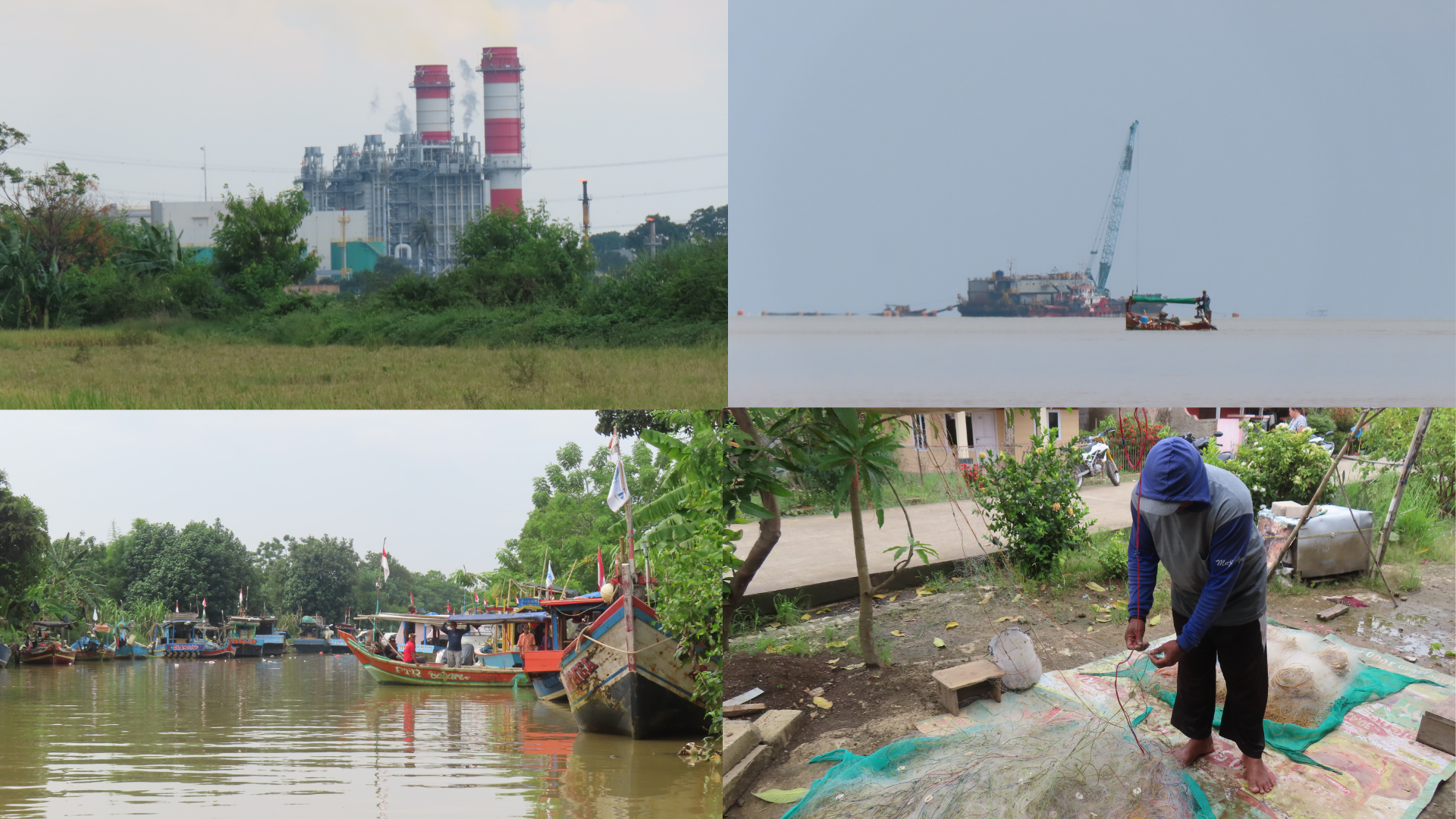
“Today I caught only a few fish. I have been going out to fish since I was in elementary school, but since this project started, the catch has been nowhere near what it used to be.”
“During the construction, many large work vessels came, and that was when we first learned that pipelines would be installed in the sea. Our fishing nets often get caught on the pipelines. If we try to avoid them by taking a detour, our fuel costs increase.”
On March 9, 2026, regarding the Jawa 1 gas-fired power plant project in West Java, Indonesia—promoted by Japanese public and private entities—local fishers’ groups submitted a letter to the Japan Bank for International Cooperation (JBIC), which is wholly owned by the Japanese government, requesting appropriate action. They report that many fishers are facing severe livelihood challenges, including significant declines in fish catches.
The letter was submitted by GKNKS (Karawang-Subang Fisherfolk Group Association), a group of fishers from Karawang and Subang regencies in West Java who have been affected by the project (with more than 300 members), together with the Indonesian Forum for the Environment (WALHI), which supports them. The letter points out that no appropriate consultation with the affected fishing community was held prior to the start of construction and that fishers’ livelihoods have not improved nor restored to pre-project levels. It therefore argues that the project violates the“JBIC Guidelines for Confirmation of Environmental and Social Considerations” (the “Guidelines”).
As the project operator has failed to respond adequately to the fishers’ complaints about their deteriorating livelihoods, the fishers’ group filed a class action lawsuit in December 2025 at the Karawang District Court. The case is currently ongoing. The fishers are demanding that the project operator, PT Jawa Satu Power (JSP)—in which Marubeni holds a 40% stake and Sojitz holds 20%—halt project activities that are causing significant impacts on the local marine ecosystem and restore the polluted marine environment. They are also seeking compensation for the losses suffered by fishers to date.
The Jawa 1 project is Asia’s first “Gas-to-Power” project, integrating power generation facilities with gas infrastructure. Commercial operations began in 2024. To supply liquefied natural gas (LNG. Procured from Tangguh LNG in West Papua) to the 1,760 MW gas-fired power plant, a Floating Storage and Regasification Unit (FSRU) and approximately 14 km of subsea pipeline were installed in nearby waters. JBIC, which provided co-financing for the project together with the Asian Development Bank (ADB) and commercial banks, is the project’s largest lender, contributing approximately USD 604 million.
The letter argues that “JBIC should not have financed this project” and calls on the bank to take responsibility. JBIC is urged to listen carefully to the voices and demands of the fishers affected by the project and to take prompt and appropriate action.
For more details, please see below.
(This is a translation by WALHI West Java- The original document was written in Indonesian.)
> PDF available here
Re: JBIC’s Responsibility and Violations of Environmental and Social Guidelines Concerning the Java 1 Gas-Fired Power Plant Project in West Java Province, Indonesia
(This is a translation by WALHI West Java- The original document was written in Indonesian.)
March 9, 2026
Mr. Nobumitsu Hayashi, Governor, Japan Bank for International Cooperation (JBIC)
We are a fishing community group in Karawang and Subang Regencies, affected by the “Jawa 1 Gas-to-Power Project” (Java 1 Gas-Fired Power Plant Project; hereinafter, the Project) in West Java, Indonesia, and local NGOs that have supported them. On October 18, 2018, your bank signed a loan agreement for the Project, with the maximum loan amount of approximately USD604 million (JBIC portion).[1]
Given that your bank has provided the largest financing for the Project, we have decided to send this letter. The first thing we would like to convey to your bank is that you should not have financed the Project. This is because there was no appropriate consultation with the many fishing communities severely harmed by the Project prior to its construction. Furthermore, with the Project now constructed and operational due to loans from financial institutions including your bank, the livelihoods of these fishing communities have neither improved nor even restored to their pre-Project levels. We understand these facts violate your own “JBIC Guidelines for Confirmation of Environmental and Social Considerations” (hereafter, the Guidelines).
First, we will explain how the construction and operation of the Project have placed the livelihoods of fishing communities in severe hardship conditions.
The fisherfolk participating in the Gabungan Kelompok Nelayan Karawang-Subang (GKNKS: Karawang-Subang Fisherfolk Group Association), who signed this letter, now exceed 300 members. Regardless of whether they own fishing boats or their age, they have made fishing their livelihood since before the Project began. Many of these experienced fisherfolk have been fishing since elementary school, and this way of life has been passed down from the parents’ generation to the younger generation. The fisherfolk have continued catching fish, crabs, squid, and shrimp, adapting their fishing methods as needed. The women in the fisherfolk’s families also play vital roles, diligently working daily on making and maintaining fishing nets.
However, since construction of the Project began, fishing households have been struggling with a significant decline in their catch. The majority claim their catches have halved or declined even further. While several factors are possible, we believe the primary cause is related to the Project: specifically, the installation of the subsea pipeline extending to the Floating Storage and Regasification Unit (FSRU) and the establishment of water intake and discharge points in the sea area necessary for the power plant’s operation.
During construction, dredging of the seabed and dumping of excavated sediment occurred in fishing grounds to install pipelines and intake/outlet structures. These operations may have significantly impacted the marine environment. Furthermore, since the power plant commenced commercial operation, the large volume of seawater drawn through the intake structure has affected marine life ranging from plankton to small and medium-sized fish. The impact of thermal water discharged into the sea from the outlet on marine life cannot be overlooked, either. Since the Project began, catches in the area have continuously declined. The tragic situation where fisherfolk repeatedly endure catches of zero or just a few fish must be recognized as a serious problem.
It must also be noted that the presence of subsea pipelines has caused countless fishing nets to be damaged or lost. Because the pipelines are not buried in the seabed, fishing nets set by fisherfolk at sea get caught on the pipes. No matter how careful the fisherfolk are, currents can also drift their nets toward the pipes. This continues to happen frequently to this day. The frequency varies among fisherfolk—ranging from several times for years, to ten times a year, or even multiple times a week—but nearly all fisherfolk have experienced it. If fishing nets are damaged or lost completely, fisherfolk must purchase materials and invest time and labor to repair or remake them. However, without clear information on where to file complaints or whether anyone will compensate for these losses, the burden on fisherfolk continues to grow.
Under these circumstances, some fisherfolk have to pay higher fuel costs per fishing trip—either by detouring around the pipeline to reach fishing grounds or traveling farther afield to maximize catches. Declining catches, increased expenses from damaged nets, and increase in fuel costs have left some unable to earn sufficient income for their livelihoods. These households are forced into daily borrowing, trapped in a vicious cycle of debt. Furthermore, some fisherfolk have been forced to sell their fishing boats because they cannot afford maintenance and repair costs.
Despite suffering such severe impacts from the Project, many in this fisherfolk group only learned about the installation of the subsea pipeline during the construction period, through direct observation on-site. In other words, they first became aware of it when numerous large construction vessels appeared in the waters and began installing the pipeline, which they saw or heard about at the time. This indicates that no explanatory meeting, known as a Socialisasi, was held for these fisherfolk prior to construction. The reality is that many fisherfolk did not participate in consultations about the Project or its impacts before construction began and were not given the opportunity to express concerns or objections regarding potential impacts from the installation of pipelines, intake/outlet structures in the sea, and other activities.
The fisherfolk group that signed this letter filed a class action lawsuit in Karawang District Court in December 2025. This is because the project operator that your bank provided financing to has taken no appropriate action at all toward the affected fisherfolk to date. The fisherfolk group demands that the operator, PT Jawa Satu Power (JSP), cease its operations, which are causing significant damage to the marine ecosystem in the area, restore the polluted marine environment, and provide compensation for the losses suffered by the fisherfolk throughout this period.
As we stated initially, we believe your bank should not have financed the Project. However, the Project has already been completed with your bank’s financing and continues to operate today. While the project operator’s responsibility is clear, we find the responsibility of your bank, which provided financial support for the Project, impossible to overlook. This is because, as a result of serious failures in your bank’s financing decision and subsequent monitoring, the fisherfolk from GKNKS continue to severe livelihood hardships up to the present day.
In deciding to provide financing for the Project, your bank asserted that “It is confirmed that appropriate plans have been made and appropriate measures have been taken for local people who are affected by the project.”[2] However, as described above, no such response plan has been made for the fisherfolk of the group signing this letter, nor has any appropriate measure been taken for them. This fact clearly indicates a violation of the Guidelines, including the failure to hold any consultation with people whose livelihoods are affected. It is highly likely that your bank failed to recognize or ignored the existence of fisherfolk like those in the group who signed this letter during your decision-making process regarding the loan. We consider this to be a serious failure on your part.
Furthermore, despite the fact that your bank, which provided financing for the Project, should still be monitoring it, you have taken no effective action whatsoever regarding the ongoing violations of the Guidelines occurring within the Project. Specifically, despite the continued violation of the Guidelines—where the livelihoods of the fisherfolk in GKNKS have not improved or restored to their pre-Project levels—your bank has taken absolutely no action. We consider this, too, to be a serious failure on your part.
We strongly urge your bank to take prompt and appropriate measures as its responsibility to ensure that the demands of the fisherfolk group—who have suffered grave impacts from the Project yet have not received appropriate measures thus far—are fulfilled. These demands include adequate and sufficient compensation for losses incurred to date, as well as the restoration of fishing grounds and the marine ecosystem to their original state.
Sincerely,
SIGNATORIES:
Gabungan Kelompok Nelayan Karawang-Subang (GKNKS)
WALHI West Java
Wahana Lingkungan Hidup Indonesia
Cc:
Ms. Satsuki Katayama, Minister of Finance
Mr. Ryosei Akazawa, Minister of Economy, Trade and Industry
Mr. Toshimitsu Motegi, Minister for Foreign Affairs
Mr. Atsuo Kuroda, Chairman and CEO, Nippon Export and Investment Insurance (NEXI)
Mr. Akihiko Tanaka, President, Japan International Cooperation Agency (JICA)
Mr. Masato Kanda, President, Asian Development Bank
Mr. Masayuki Omoto, President and CEO, Marubeni Corporation
Mr. Kosuke Uemura, Representative Director, President & CEO, Sojitz Corporation
Mr. Takeshi Hashimoto, President & CEO, Mitsui O.S.K. Lines, Ltd.
Mr. Masahiro Kihara, President & Group CEO, Mizuho Financial Group, Inc.
Mr. Hironori Kamezawa, Member of the Board of Directors, President & Group CEO, Mitsubishi UFJ Financial Group, Inc.
Mr Tan Teck Long, Group Chief Executive Officer, Oversea-Chinese Banking Corporation Limited
Mr. Benjamin LAMBERG, Representative in Japan, Crédit Agricole Corporate and Investment Bank, Tokyo Branch
Mr. Bruno Gaussorgues, Representative in Japan, Société Générale Bank Tokyo Branch
Contact:
WALHI West Java
Address: Jalan Simphoni No. 29, Kel. Turangga, Kec. Lengkong, Kota Bandung, Jawa Barat 40264, Indonesia
TEL: +62 22 63175011
Email: walhijabar@gmail.com
[1] https://www.jbic.go.jp/en/information/press/press-2018/1022-011485.html
[2] https://www.jbic.go.jp/en/business-areas/environment/projects/image/60612_8.pdf

