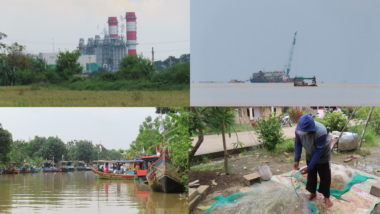
Indonesia’s Jawa 1 Gas-Fired Power Plant Project: Local Fishers' Group and NGO Demand Independent Investigation by JBIC—Pointing out "Stark Gap Between Proponent's Monitoring Reports and Actual Damages Suffered by Fishers"
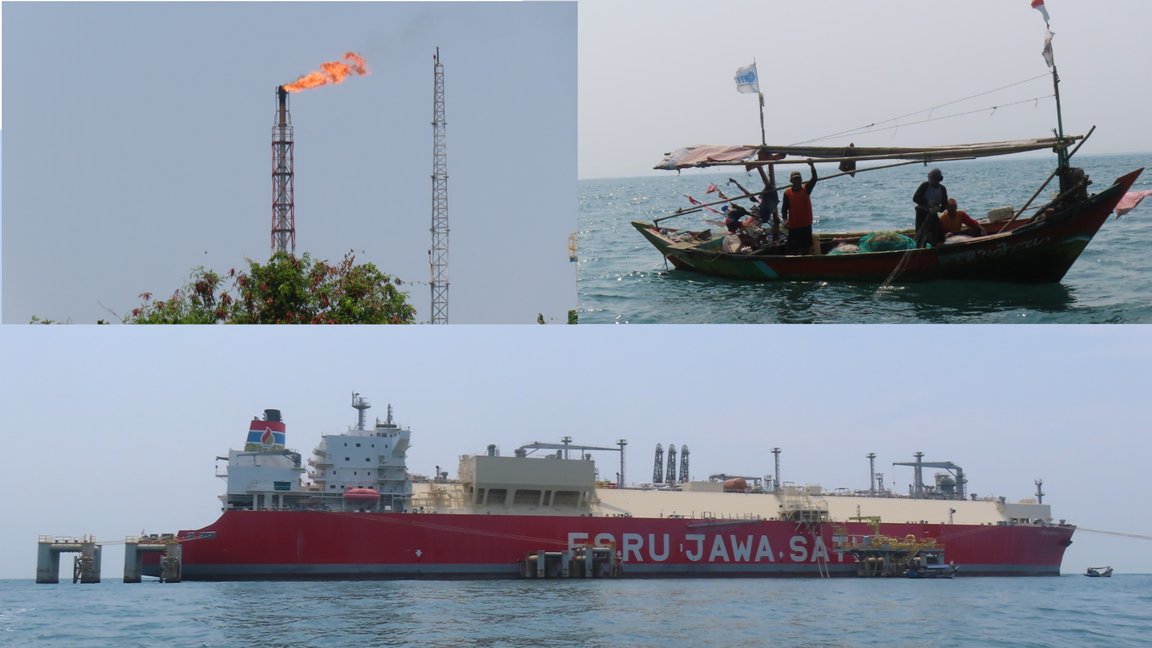
On October 8, 2026, regarding the Jawa 1 gas-fired power plant project in West Java, Indonesia, promoted by the Japanese public and private sectors, local fishers’ group GKNKS and their supporting organization, the Indonesian Forum for the Environment (WALHI), submitted a petition to the Japan Bank for International Cooperation (JBIC; wholly owned by the Japanese government), calling for an independent investigation, verification, and evaluation.
The fishers’ group and their supporters previously submitted a letter to JBIC in March 2026, conveying the harsh reality faced by local fishers forced into severe livelihoods due to adverse impacts of the Project, such as significant drops in fish catches and the damage to or loss of fishing nets. However, the newly submitted petition points out that, even now—more than six months later—no fundamental solutions have been implemented on the ground to address the issues faced by the fishers.
Furthermore, the petition criticizes the stark gap between JBIC’s perception that “no particular problem has arisen" and the actual experiences and realities of the fishers who continue to suffer from the Project’s impacts. It highlights that a major cause of this discrepancy is JBIC’s sole reliance on reports from the project proponent in its monitoring process and its failure to conduct objective verification.
JBIC is the largest lender to the Project (providing approximately USD 604 million) and extended co-financing alongside the Asian Development Bank (ADB) and commercial banks to the project company, PT Jawa Satu Power (JSP; invested 40% by Marubeni Corporation and 20% by Sojitz Corporation).
The gas-fired power project is Asia’s first “Gas-to-Power" project (an integrated development of power generation and gas-related facilities), which commenced commercial operations in 2024. To supply liquefied natural gas (LNG) fuel to the 1,760 MW gas-fired power plant, a Floating Storage and Regasification Unit (FSRU) and a transmission pipeline (approximately 14 km subsea) were installed in adjacent coastal waters. However, the fishers’ group reports a lack of proper consultations from prior to construction up to the present, as well as devastating impacts on their livelihoods.
JBIC is strongly urged to sincerely listen to the voices of the fishers affected by the Project and take prompt and appropriate measures to ensure that appropriate and sufficient compensation is provided for past losses, and that the original state of the fishing ground environment and marine ecosystem is restored.
For more details, please see below.
(This is a translation by WALHI West Java- The original document was written in Indonesian.)
> PDF available here
Request for Addressing Deficiencies in JBIC’s Monitoring and Conducting an Independent Investigation, Verification, and Evaluation Regarding the Jawa 1 Gas–Fired Power Plant Project in West Java, Indonesia
(This is a translation by WALHI West Java- The original document was written in Indonesian.)
October 8, 2026
Mr. Kazuhiko Amakawa, Governor, Japan Bank for International Cooperation (JBIC)
More than six months have passed since we submitted our letter dated March 9 this year regarding the “Jawa 1 Gas-to-Power Project" (Jawa 1 Gas-Fired Power Plant Project; hereinafter, the Project) in West Java, Indonesia, for which the Japan Bank for International Cooperation (JBIC) signed a loan agreement on October 18, 2018[1]. Regrettably, appropriate and effective measures have still not been taken to address the issues we communicated to JBIC, such as the significant decline in fish catches and the damage to or loss of fishing nets, leaving local fishing communities forced to live under severe conditions.
Following the submission of our previous letter, we confirmed JBIC’s understanding regarding the impacts of the Project on local fishing communities, which Friends of the Earth Japan (FoE Japan) obtained through a meeting and email correspondence with JBIC. While we had already pointed out JBIC’s “serious failures in monitoring" in our previous letter, the understanding communicated by JBIC to FoE Japan strongly suggests that there are serious flaws in the method and quality of JBIC’s monitoring.
For example, regarding the impacts of the subsea pipeline installation, JBIC explained, based on reports from the project proponent, that “fishing activities are restricted along the subsea pipeline," and where the pipeline is not buried, “concrete mattresses are applied to protect the pipeline and secure it to the seabed at the same time." In other words, we understand that JBIC takes the position that no particular problem has arisen.
However, regarding such fishing restriction measures, the local fishing community group (GKNKS) has repeatedly stated that they “have never received any explanation." It is extremely doubtful at what stage—before or during contraction, or after the start of operations—to whom (which fishing community), and how the project proponent provided explanations, and whether appropriate consent was obtained from all affected fishing communities. This serves as proof that consultations with affected residents regarding the Project’s impacts have not been appropriately carried out to this day while we have already pointed out in our previous letter that meetings called “Socialisasi" were not conducted before construction.
Furthermore, the problems faced by fishing communities on the ground continue to this day. Looking at the situation over the past month alone, reports from just four fisherfolk belonging to GKNKS confirm that at least 26 fishing nets were damaged. JBIC may assume that no further measures are necessary because fishing restrictions are in place; however, from the perspective of the fishing community group, it is impossible to say that appropriate and safe installation measures for the subsea pipeline have been implemented in their fishing grounds.
Regarding the grievance mechanism, JBIC appears to evaluate, based on information in the project proponent’s semi-annual monitoring reports, that “grievances are being appropriately addressed and the mechanism is functioning effectively." However, as stated in our previous letter, from the perspective of the fishing community group, it remains unclear where they should submit complaints when suffering damages, making it evident that the mechanism lacks effectiveness.
Thus, there is a stark gap between JBIC’s perception and the actual experiences and realities of the fishing communities who have been affected by the Project on the ground. We believe part of the reason lies in JBIC’s sole reliance on reports from the project proponent in its monitoring and its failure to conduct objective verification. JBIC should directly confirm reports from third parties, including us, and if discrepancies exist between these and the project proponent’s reports, JBIC itself should conduct an independent investigation, verification, and evaluation through measures such as on-site inspections.
In particular, concerning the verification of the situation where the livelihoods of fisherfolk in the fishing community group have not been improved or restored to their pre-Project levels—which we pointed out in our previous letter as a violation of the “JBIC Guidelines for Confirmation of Environmental and Social Considerations" (hereinafter, the Guidelines)—a comparison between appropriate baseline data regarding fishing communities’ livelihoods (including fish catches) and the current situation must be conducted through methods that do not rely solely on reports from the project proponent. A key point to note in this process is whether the compensation and livelihood restoration programs provided by the project proponent are truly effective in light of the objective to improve or restore living standards. This is because, while the project proponent provided fishing nets and other materials to hundreds of fisherfolk in Karawang and Subang Regencies in August this year, such provisions do not constitute a fundamental solution to the problems faced by the fishing communities, such as significant decline in catches, damage to or loss of nets, and income loss.
Up to now, JBIC appears to have focused primarily on confirming the operational status of the Project during its monitoring site visits. However, during these visits, JBIC should also sincerely listen to the voices of the affected fishing community group from an environmental and social perspective, and ensure that the project proponent takes appropriate actions in accordance with the Guidelines.
We reiterate our strong demand that JBIC fulfill its responsibilities and take prompt, effective, and appropriate measures to ensure that fishing communities who have suffered grave impacts from the Project without receiving appropriate measures to date are provided with adequate and sufficient compensation for past losses, and that the original state of the fishing ground and marine ecosystem is restored.
Sincerely,
SIGNATORIES:
Gabungan Kelompok Nelayan Karawang-Subang (GKNKS)
WALHI West Java
Wahana Lingkungan Hidup Indonesia
Cc:
Ms. Satsuki Katayama, Minister of Finance
Mr. Ryosei Akazawa, Minister of Economy, Trade and Industry
Mr. Toshimitsu Motegi, Minister for Foreign Affairs
Mr. Atsuo Kuroda, Chairman and CEO, Nippon Export and Investment Insurance (NEXI)
Mr. Akihiko Tanaka, President, Japan International Cooperation Agency (JICA)
Mr. Masato Kanda, President, Asian Development Bank
Mr. Masayuki Omoto, President and CEO, Marubeni Corporation
Mr. Kosuke Uemura, Representative Director, President & CEO, Sojitz Corporation
Mr. Jotaro Tamura, President & CEO, Mitsui O.S.K. Lines, Ltd.
Mr. Masahiro Kihara, President & Group CEO, Mizuho Financial Group, Inc.
Mr. Junichi Hanzawa, Member of the Board of Directors, President & Group CEO, Mitsubishi UFJ Financial Group, Inc.
Mr Tan Teck Long, Group Chief Executive Officer, Oversea-Chinese Banking Corporation Limited
Mr. Benjamin LAMBERG, Representative in Japan, Crédit Agricole Corporate and Investment Bank, Tokyo Branch
Mr. Bruno Gaussorgues, Representative in Japan, Société Générale Bank Tokyo Branch
Contact:
WALHI West Java
Address: Jalan Simphoni No. 29, Kel. Turangga, Kec. Lengkong, Kota Bandung, Jawa Barat 40264, Indonesia
TEL: +62 22 63175011
Email: walhijabar@gmail.com
[1] https://www.jbic.go.jp/en/information/press/press-2018/1022-011485.html