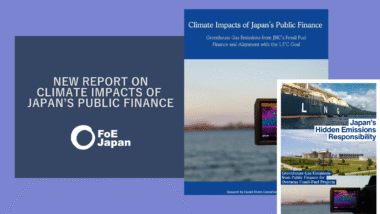
[PRESS RELEASE] JBIC's Financed Emissions Equal Those of the World's 28th-Largest Emitter: Four Environmental NGOs Call for a Mid-Term Reduction Target Aligned with 1.5°C at COP31
See the Full Text of the Joint Statement Here.
Four NGOs, Friends of the Earth Japan, the Japan Center for a Sustainable Environment and Society (JACSES), Mekong Watch and Kiko Network, today released a joint statement addressed to the Japan Bank for International Cooperation (JBIC) and the Japanese government. JBIC has now disclosed its financed emissions for the first time, and in light of that disclosure the groups call for a mid-term emission reduction target aligned with the 1.5°C goal of the Paris Agreement.
■ Background
In August, JBIC disclosed the greenhouse gas emissions of its loan and investment portfolio for the first time in its Integrated Report 2026. Across Scopes 1 to 3, the total is 236.5 million tonnes of CO2-equivalent. If JBIC were a country, its total CO2 emissions would exceed those of Spain, the UAE and Qatar, ranking 28th in the world. The figure is about a quarter (23.8%) of Japan’s total domestic emissions. Japan’s NDC has never covered emissions generated overseas through public money. JBIC’s own disclosure now shows how large this “hidden emissions responsibility" is.
■ Key Points of the Statement
- Transparency deserves recognition: By disclosing Scope 3 emissions, emissions for each of 19 sectors and data quality scores, JBIC has set a high standard among the world’s export credit agencies. Other agencies should follow its lead.
- Gas-fired power is not “avoided emissions": Once methane leakage is included, one study finds that the lifecycle emissions of US LNG exceed those of coal. Mineral resource development, a sector where environmental, social and human rights harms keep occurring, should not be counted as a “contribution" to emission reductions either.
- Methane emissions remain opaque: FoE Japan estimates that 46% of the direct emissions of JBIC-backed projects come from methane. Methane must be calculated and disclosed separately from CO2.
- Fossil fuel lending grows with no mid-term target: Fossil fuel-related projects that JBIC decided to finance in 2025-26 total about USD 9.9 billion (about JPY 1.5 trillion). UK Export Finance (UKEF) and others have set 2030 targets, yet JBIC says only that it is developing a plan for net zero by 2050. Even after their loans are fully repaid, the power plants it finances will keep emitting until around 2060.
■ Key Recommendations
- By its 2027 Integrated Report, JBIC should publish a target that includes a 2035 target for reducing financed emissions, set in absolute terms and including Scope 3. It should also end all new finance that leads to fossil fuel expansion immediately.
- The Japanese government should include a target for reducing JBIC’s financed emissions in the next Strategic Energy Plan and in Japan’s NDC.
- JBIC should calculate and disclose methane and CO2 separately, and require borrowers to carry out measurement-based MRV (measurement, reporting and verification).
- JBIC should join the Net-Zero Export Credit Agencies Alliance (NZECA). When it revises its own environmental guidelines in 2027, it should build climate and methane MRV frameworks into its financing review.
Full statement:
https://foejapan.org/wpcms/wp-content/uploads/2026/11/JBIC-disclosure-joint-statement.-EN.-Final.pdf
[Contact]
Hiroki Osada, Friends of the Earth Japan
1-21-9 Komone, Itabashi-ku, Tokyo 173-0037, Japan | osada@foejapan.org