[Press Release] Pacific Metals Acknowledges De Facto Non-Compliance with Supply Chain Human Rights Guidelines in Written Reply to NGO
July 29, 2026
Friends of the Earth Japan
Pacific Asia Resource Center (PARC)
On July 15, 2026, Friends of the Earth Japan (FoE Japan), an international environmental NGO, and the Pacific Asia Resource Center (PARC), both based in Tokyo, received a response from Pacific Metals Co., Ltd. (PAMCO), a major Japanese non-ferrous metals company, to a letter of inquiry the two organizations had sent on June 16, 2026, concerning the environmental and human rights issues surrounding the Rio Tuba nickel mine development on Palawan Island, the Philippines. The two organizations point out that PAMCO’s response effectively amounts to a declaration of non-compliance with the Japanese government’s Guidelines on Respecting Human Rights in Responsible Supply Chains (the “Guidelines”) — the very framework PAMCO claims to rely on. It has also become clear that this irresponsible management, arguably itself a violation of the Guidelines, lies behind the environmental pollution and human rights risks that have been left unaddressed around the Rio Tuba nickel mine for many years.
Questionnaire: Pacific Metals Letter of Inquiry (Japanese)
Response: Pacific Metals Response (Japanese)
The fundamental problem with PAMCO’s response is the complete lack of any willingness to investigate or verify the concerns regarding local legal violations, environmental destruction, and risks of human rights abuses. Citing its status as a listed company, PAMCO stated that “it is difficult to necessarily respond regarding non-public information,” and limited their answers entirely to speaking on behalf of reports from Nickel Asia Corporation (NAC), the parent company of the project operator, Rio Tuba Nickel Mining Corporation (RTNMC). This significantly deviates from international norms and standards, as well as from the Guidelines that PAMCO purports to reference. The Guidelines state that “it is important for business enterprises not to delegate all efforts to respect human rights to their business partners in a direct contractual relationship, but to engage in activities to respect human rights together.” PAMCO asserts its respect for human rights as a key management issue while relying solely on legal compliance and self-reporting from the local operator. However, this stance completely deviates from the fundamentals of due diligence and contradicts the Guidelines they claim to rely on.
Due Diligence Reduced to a Formality
Regarding the expansion plan for the Rio Tuba Nickel Mine, PAMCO responded, “We understand that the government would not grant permission if the area were a development-prohibited zone, and since the business is operating having obtained permission from the government, we understand the concerns are unwarranted.” However, such a response clearly violates the spirit of the Guidelines. The Guidelines explicitly state that “compliance with national laws and regulations does not necessarily imply that the corporate responsibility to respect human rights has been satisfied” and that “compliance with the laws and regulations in each country and the corporate responsibility to respect human rights are not necessarily the same.” They further state that “if the laws and regulations or enforcement of a country do not appropriately protect internationally recognized human rights, business enterprises will need to seek ways to respect internationally recognized human rights to the greatest extent possible.”
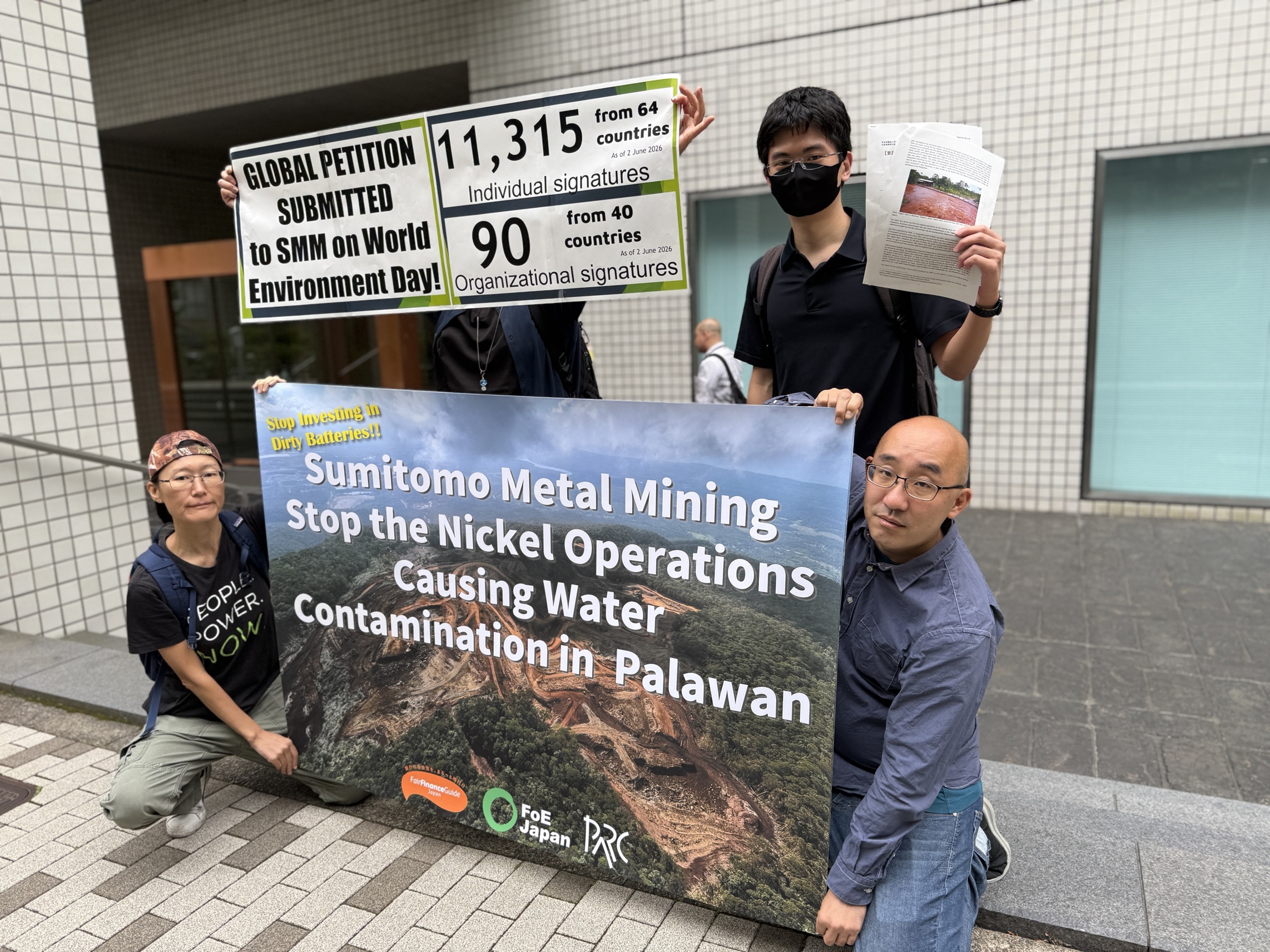
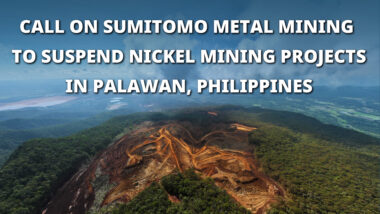
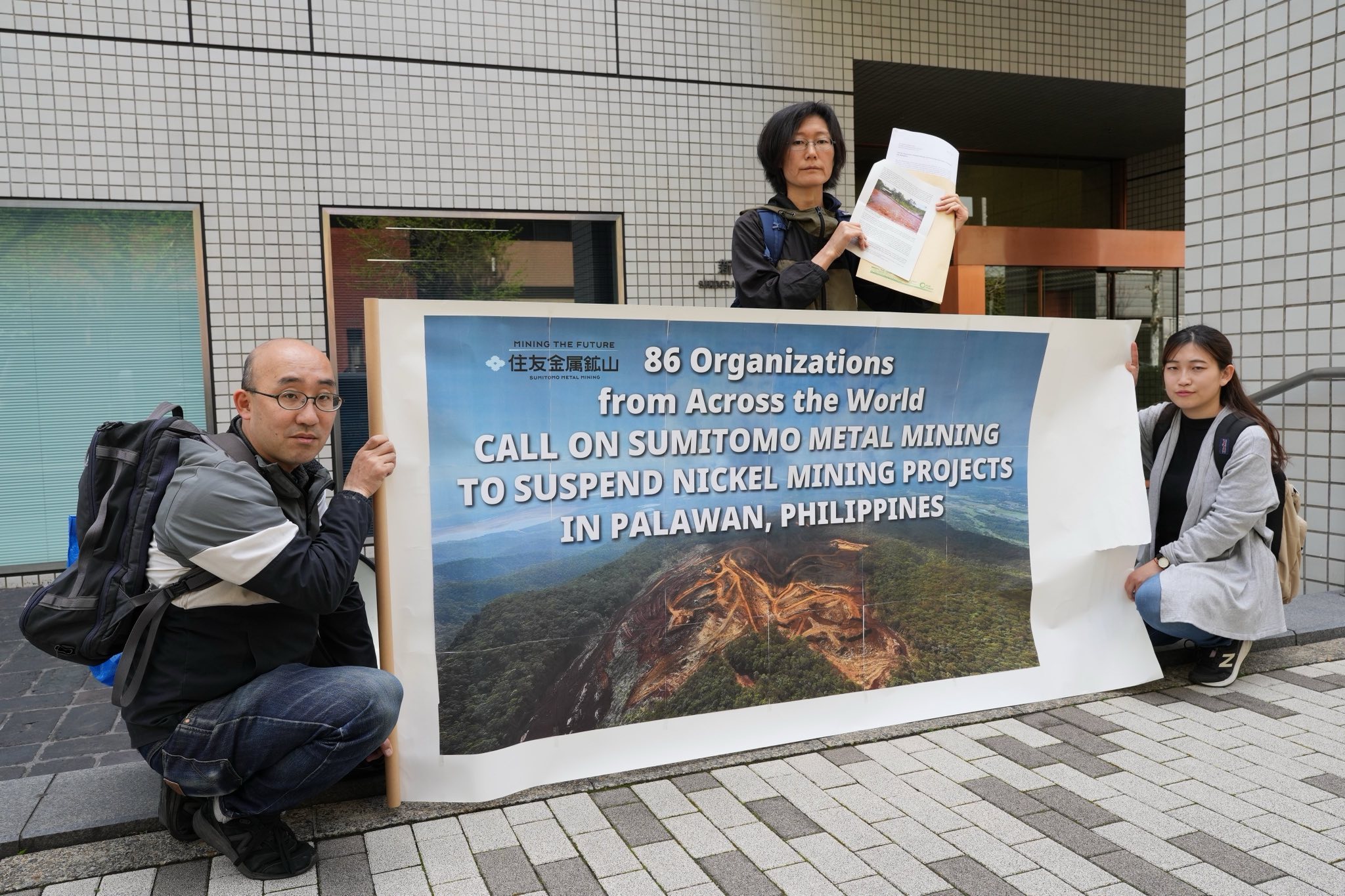
Furthermore, Mount Bulanjao, which lies within the area targeted by the Rio Tuba mine’s expansion plan, is a region of rich biodiversity and encompasses critical forests and watersheds upon which indigenous peoples and local communities deeply depend for their livelihoods. Indigenous peoples and local communities whose lives depend on this forest and its watershed, together with the local environmental group ELAC, have voiced grave concerns over Special Tree Cutting and Earth Balling Permits (STCEP) for a total of 87,090 trees in the area covered by the expansion plan, issued by the Department of Environment and Natural Resources (DENR) of the Philippines since 2024. Also, in June of this year, an international petition, signed by more than 11,000 individuals across 64 countries and endorsed by 90 organizations from 40 countries, calling for the suspension of the project, was submitted to Sumitomo Metal Mining, a business partner in the project. This demonstrates that many questions are being raised internationally regarding the Rio Tuba Nickel Mine’s operations. PAMCO’s attitude of ignoring the reality of global protests and dismissing concerns as “unwarranted” is highly insincere. The Guidelines also state that “when assessing adverse human rights impacts, business enterprises should pay special attention to potential adverse impacts on vulnerable individuals, namely, individuals from groups or populations that may be at heightened risk of becoming socially vulnerable or marginalized.” No such attention has been paid at all here, and due diligence has been reduced to a mere formality.
Ineffective Grievance Mechanism
PAMCO claims that as part of their “Human Rights Initiatives,” they have established a basic policy on human rights respect, are working to build a human rights due diligence system, and continue to implement the system. However, regarding PAMCO’s hotline, which is one of the grievance mechanisms under these initiatives, the company responded “no foreign-language hotline has been established.” Also, they made no mention of the possibility of implementing multilingual support in the future, answering as if this were a matter of course. This can hardly be called an effective hotline. The local Indigenous peoples and residents, who are most vulnerable to the project’s impacts, speak Palawan, Tagalog, and other local languages as their mother tongues, and it is obvious that they cannot report through the hotline in Japanese. PAMCO’s system in practice shuts residents out from raising grievances directly, even as PAMCO holds up respect for human rights across its supply chain. As for the local grievance channel, PAMCO stated only that “we have been informed that one has been set up,” without clearly explaining how anonymity is ensured, and offered no explanation whatsoever of any measures to protect complainants from retaliation.
Under the Japanese government’s Guidelines, “Accessible” is an essential requirement for a grievance mechanism, which requires “providing adequate assistance for those who may face particular barriers to access, which may include language, literacy, and fears of reprisal.” PAMCO’s system, which effectively shuts out grievances from local communities whose mother tongues are Palawan, Tagalog, and other local languages, who are the most vulnerable to the impacts, completely violates this requirement. Moreover, with respect to the Guidelines’ other requirements, such as being legitimate, predictable, equitable, transparent, rights-compatible, a source of continuous learning, and based on engagement and dialogue, PAMCO’s grievance mechanism structure must be said to deviate significantly from the Guidelines.
Ignoring 15-Plus Years of Hexavalent Chromium Contamination
In the Togpon River, which flows near the Rio Tuba nickel mine, hexavalent chromium — a known carcinogen — has continued to be detected at levels exceeding both World Health Organization (WHO) drinking-water standards and local environmental standards for more than 15 years. Although we presented an investigative report on this serious water contamination, PAMCO responded briefly that “we have been informed by the mining company that it is responding appropriately in light of local laws and regulations.”
It has been pointed out, based on the aforementioned water quality monitoring, that the clearing of forests and the subsequent exposure of topsoil without effective pollution countermeasures may be one of the primary causes of hexavalent chromium runoff. The Guidelines state that where a company’s operations are directly linked to an adverse human rights impact, the company should strive to prevent or mitigate that impact by using its leverage on the entities that cause or contribute to it. Yet PAMCO made no mention whatsoever of any concrete countermeasures or third-party verification, abandoning the exercise of its leverage. Despite concerns that the ongoing mining expansion could worsen the contamination and expose Indigenous peoples and farmers — who rely on the river for domestic and agricultural water — to health risks for decades to come, PAMCO shows a lack of willingness to directly address the risks to the lives and health of local residents.
In Closing
PAMCO’s response clearly demonstrates its consistent refusal to confront the reality of environmental destruction, water pollution, and human rights violation risks on the ground. While PAMCO takes pride in saying that it “conducts human rights due diligence as appropriate, examines matters properly in light of its own circumstances, and discloses this in its Integrated Report,” its practice of brushing aside the serious health risks facing local residents and the concerns of Indigenous peoples with the single line “we have been informed” by the local operator is nothing but greenwashing that treats human rights as a mere public-relations tool. It must be said that they have significantly abandoned their responsibilities in the supply chain as investors and procurers.
Hikaru Matsumoto of FoE Japan’s Development and Human Rights Team commented: “This response from PAMCO can only be described as a complete abdication of the core of human rights due diligence demanded of companies today. There is a severe lack of perspective in considering the local residents. Also, the fact that they have not even provided an accessible grievance channel for the residents, who are supposed to be the most affected, speaks volumes about whose interests PAMCO’s professed respect for human rights is really meant to serve. At the same time, this raises questions about how the Japanese government will respond to companies that openly neglect government-issued guidelines. If companies that ignore the guidelines are left unchecked, the government’s business and human rights policies themselves will become nothing but a formality. We strongly demand that PAMCO implement effective pollution countermeasures and human rights due diligence as a truly responsible enterprise, and we also call on the Japanese government to provide strict guidance.”
Shigeru Tanaka, Executive Director of Pacific Asia Resource Center (PARC), expressed concern that Pacific Metals’ sloppy supply chain due diligence poses a supply chain risk for many Japanese manufacturers. He commented, “Internationally, the required standards for due diligence have been rising in recent years. Under circumstances where risks cannot be anticipated or proactively addressed by ‘leaving it to the locals,’ responsible manufacturers will no longer be able to use minerals refined by Pacific Metals with confidence. Manufacturers who continue to use them will operate carrying the constant risk of being sanctioned or shut out from the international markets. The Japanese government should have created the guidelines to prevent such a situation that undermines Japanese international competitiveness, but the guidelines mean nothing if no one enforces them. Pacific Metals obviously needs to act, but the Japanese government must also take action to demand compliance with the guidelines.”
[Contact regarding this release]
Friends of the Earth Japan / Contact: Hikaru Matsumoto
Address: 1-21-9 Komone, Itabashi-ku, Tokyo 173-0037, Japan
Phone: +81-3-6909-5983 / Email: matsumoto@foejapan.org