Japanese and Indonesian Environmental NGOs Send a Follow-up Questionnaire to Hanwa Co., Ltd. to Halt Imports of Forest-Destructive Biomass Fuel.
We, FoE Japan, received the responses to our letter of request and a questionnaire on December 11st, 2025 from Hanwa Co., Ltd. urging the company to suspend imports of wood pellets from Indonesia.
We sent a follow-up questionnaire on January 21st, 2026 because there are no clear answers to our questions in the responses.
Background information
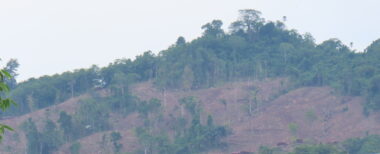
In Indonesia, so-called Industrial Plantation Forests for Energy (Hutan Tanaman Energi, HTE), which used the fuels in power plants in Japan, have been rapidly expanding for wood pellet production, and now reaching approximately 1.3 million hectares. This expansion has led to the logging of natural forests and the conversion to monoculture plantations.
As a result, Indonesian NGOs reported that there are serious concerns about biodiversity loss, increased flood risks, and negative impacts on local communities’ livelihoods and land use due to no access to the forests and their farmlands.
In particular, wood pellets produced in Gorontalo Province in northern Sulawesi are mainly for export to Japan and South Korea. We also found that there is one of the supply areas for Hanwa’s imported wood pellets.
NGOs and civil society groups in Indonesia have raised strong concerns about deforestation of natural forests, and we sent the following questionnaire in November, 2025 to urge to halt imports of wood pellets in Indonesia.
We assessed and made comments on Hanwa’s responses with Trend Asia, one of Indonesian NGOs engaging our biomass campaign in the following table.
Table of Questions and Responses
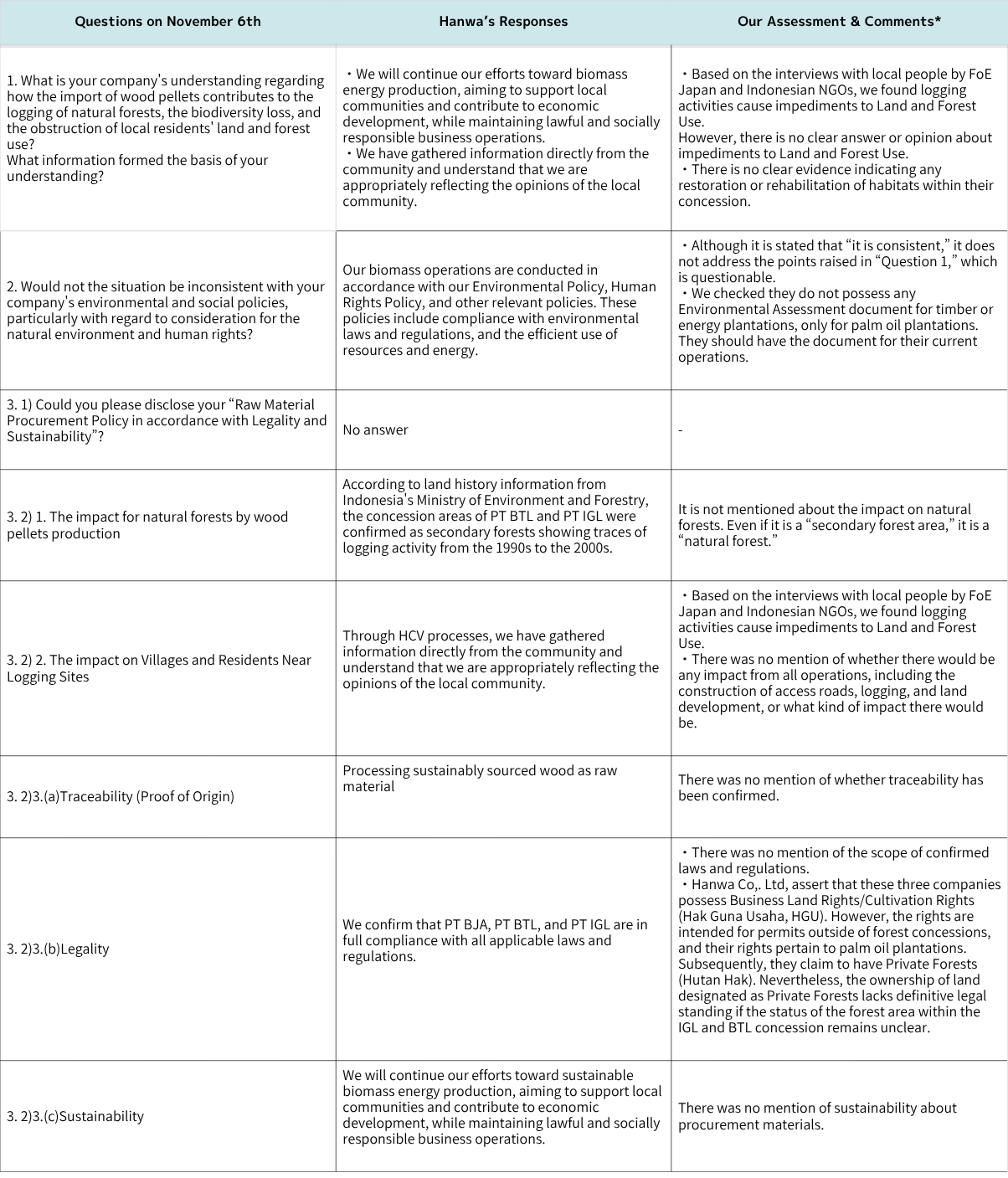
*Comments from FoE Japan and Trend Asia
The Follow-up Questionnaire on January 21st
We submitted a follow-up questionnaire on January 21st based on the above assessments and comments. It asks for Hanwa’s opinions about social and environmental impacts in communities, and the disclosure of the results’ environmental impacts assessment (the details below).
This document is a provisional English translation of the original Japanese response from Hanwa Co., Ltd., prepared by Friends of the Earth Japan.
21/1/2026
Mr. Yoichi Nakagawa
President & CEO
Hanwa Co., Ltd.
A Follow-up Questionnaire about Wood Pellets from Indonesia
We sincerely appreciate your responses (11/12/2025) to our questionnaire (6/11/2025) with 5 Japanese and Indonesian NGOs.
However, we send you this follow-up questionnaire and would be delighted with your new responses since there are no clear responses to our previous questions and no answers to some questions.
We would also appreciate it if you would kindly reconsider the possibility of an in-person meeting with us.
Thank you for your understanding.
■ Efforts toward Sustainable Biomass Production
(Response from Hanwa)
Sustainable biomass energy production is at the core of our biomass business. We source wood pellets from PT Biomasa Jaya Abadi (PT BJA), which processes wood sustainably sourced by PT BTL and PT IGL. PT BTL and PT IGL cultivate Gamal, which is harvested on a 4-5 year cycle. All forest cultivation activities are conducted in accordance with Indonesian laws and regulations.
Q1: We understand your position to be that “timber derived from clear-cutting natural forests and converting them to gamal plantations” has the same meaning as “sustainably sourced timber.” Is this correct?
Q2: We also understand that you operate gamal plantations, but it has nothing to do with the current sourced raw materials. Is this understanding correct?
(Response from Hanwa)
According to land history information from Indonesia’s Ministry of Environment and Forestry, the concession areas of PT BTL and PT IGL were confirmed as secondary forests showing traces of logging activity from the 1990s to the 2000s.
Q3: Secondary forests are still natural forests. We recognise that clear-cutting and converting this area to gamal plantations causes deforestation. Could you please tell us your opinions based on our recognition?
(Response from Hanwa)
The Gamal, which is the primary cultivated, is classified as an energy crop by the Indonesian Ministry of Environment and Forestry and as a plantation crop by the Ministry of Agriculture. The gamal is a perennial plant capable of yielding 4 to 5 harvests per planting, with a renewal cycle of approximately 4 years. Its rapid growth and strong roots make it valuable not only as a new energy resource but also for conservation and soil erosion prevention.
Q4: When did you start gamal plantations?
Do you have any plan to start importing and selling the gamal as biomass energy because you already told us it is possible to harvest for about 4 years? Or is this “Gamal” not being considered as an imported fuel?
■ Environmental and Social Considerations and Legal Compliance
(Response from Hanwa)
We confirmed that PT BJA, PT BTL, and PT IGL are in full compliance with all applicable laws and regulations. PT BTL and PT IGL obtained Land Use Rights/Cultivation Rights (HGU) from the Gorontalo Provincial Office of the National Land Agency (BPN) in 2013 and 2014, respectively. In 2020, they also received “Private Forest (Hutan Hak)” designation from the Ministry of Environment and Forestry for timber and forest product utilization.
Q5: Could you please let us know specifically about confirmed laws and regulations?
The laws and regulations likely include various provisions at each stage of the supply chain, such as those concerning the acquisition of business rights, the production management of wood pellet raw materials within the business site, the manufacturing and processing of wood pellets and other factory production activities, the domestic transportation of wood pellets, and the export of wood pellets. We would appreciate it if you would make it clear how compliance with each of these provisions is verified and what documents serve as the basis for this verification.
(Response from Hanwa)
The operations of PT BTL and PT IGL are audited by independent auditors certified by the Ministry of Environment and Forestry, and both companies hold Forest Product Legality Verification (VLHH) certificates. We source wood pellets only from concession areas where assessments have been conducted in accordance with the requirements of Indonesia’s Environmental Impact Assessment (AMDAL) system.
Q6: Although you responded “The operations of PT BTL and PT IGL hold Forest Product Legality Verification (VLHH) certificates.”, you are not able to confirm about “sustainability” of raw materials. Is our understanding correct?
Q7: In addition, you also answered “We source wood pellets only from concession areas where assessments have been conducted in accordance with the requirements of Indonesia’s Environmental Impact Assessment (AMDAL) system.”, however, there are areas where AMDAL has not been conducted or is not applicable, in the concession areas operated by PT. BTL and PT. IGL. Is our understanding correct?
Q8: Is it also correct to understand that PT. BTL and PT. IGL are conducting logging operations in those areas, but that these materials are not included in your company’s procurement?
■ Environmental Impact Assessment (EIA) Process
Q9: When is the EIA process implemented? and which organization approved the EIA?
Q10: Regarding step 6 of the EIA process, “Public Consultation and Approval,” there is no information provided about “local residents” or “stakeholders.” Specifically, when and to whom (e.g., officials from state, prefecture, county, village, or other local governments) was this consultation conducted?
Q11: The EIA is made publicly available during the scoping and draft stages, with a period set for soliciting comments from stakeholders. Did this EIA follow such steps? If so, when was the public comment period?
Q12: During the comment period from the above stakeholders, were any information sessions held for stakeholders?
Q13: The five organizations, including the Indonesian NGO, are interested in the results of the environmental impact assessment. Is the EIA report available to stakeholders, including local residents? Is it possible to share a copy with us?
*Indonesian is perfectly acceptable.
Q14: Are the results of the environmental monitoring conducted every six months disclosed to stakeholders, including local residents? Also, would it be possible to share a copy of the most recent environmental monitoring results/report with us?
■ Efforts toward Conservation of Biodiversity
Q15: (the same question as the above) The five organizations, including the Indonesian NGO, are interested in the results of the environmental impact assessment. Is the EIA report available to stakeholders, including local residents? Could you please share a copy with us?
*Indonesian is perfectly acceptable.
■ Community Engagement Regarding HCV Assessment
(Response from Hanwa)
PT. BTL and PT. IGL prioritize the principle of Free, Prior, and Informed Consent (FPIC). We have conducted stakeholder mapping, participatory mapping, focus group discussions, and detailed interviews with relevant key stakeholders in multiple villages, including those located downstream of the concession. Through these processes, we have gathered information directly from the community and understand that we are appropriately reflecting the opinions of the local community.
Q16: Although you answered “PT BTL and PT IGL prioritize the principle of Free, Prior, and Informed Consent (FPIC). ~~~ including those located downstream of the concession”, could you please let us know the name of areas and villages?
Q17: You also mentioned “We have conducted stakeholder mapping, participatory mapping, focus group discussions, and detailed interviews with relevant key stakeholders in multiple villages, ”when have those activities been done? Was it conducted as a separate process from the EIA or as a part of the EIA?
Q18: If the Indonesian companies claim to have gotten FPIC with grassroots communities, is there a way for us to create documentation based on community input in order to object to a company’s logging rights? If so, could you please let us know how to do it?
■ Impacts on the local communities and people
Q19: We request that your company once again let us know your perspective on the impacts on the local community and residents. As our request letter and reference materials on November 6th, we revealed that the project has hindered land and forest use and some residents have rejected the project from the outset due to concerns about flooding and landslides caused by deforestation, as well as fears of losing access to forests essential for their livelihoods as results of interviews conducted with local residents by FoE Japan and Indonesian NGOs.
Friends of the Earth Japan
National Executive of Wahana Lingkungan Hidup Indonesia (WALHI) / Friends of the Earth Indonesia
Regional Executive of WALHI Gorontalo
Forest Watch Indonesia
Trend Asia