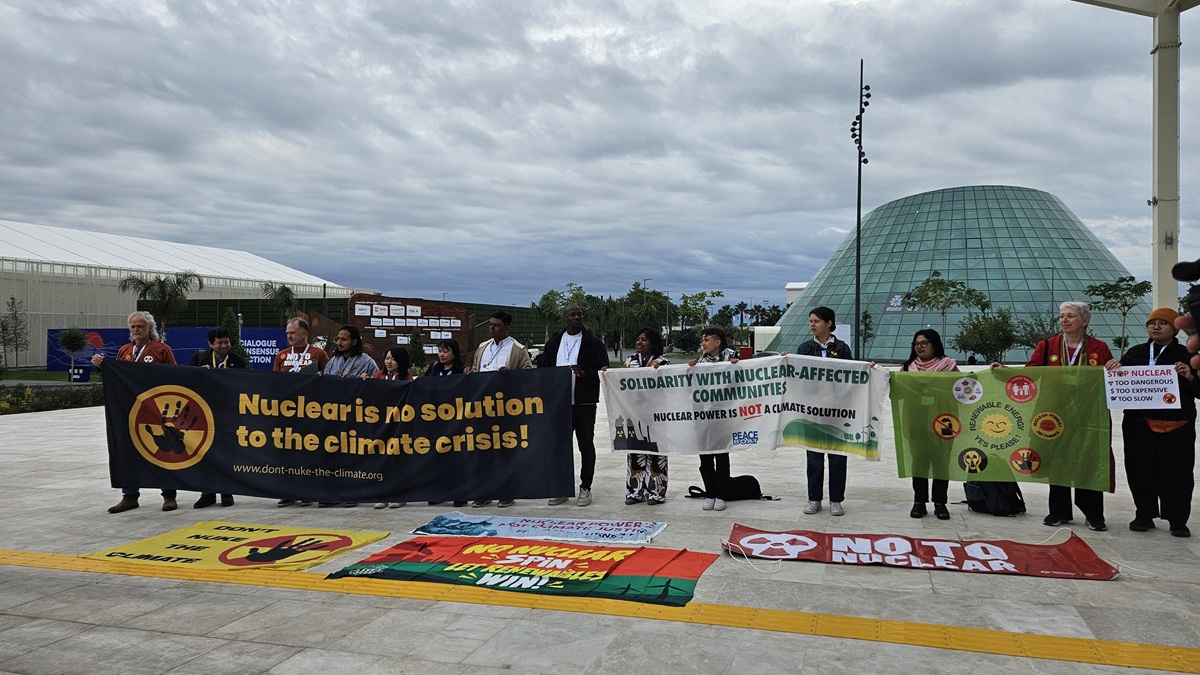
* Nuclear Free Bataan Movement drafted the original text.
– Joint Statement by Civil Society –
Nuclear Power Is a Costly Distraction from Real Climate Action
We—the undersigned civil society organizations, climate justice movements, Indigenous leaders, and public health advocates—demand that world leaders reject the nuclear lobby, enforce real climate accountability, and invest solely in safe, accessible, and immediate solutions.
Reject the unrealistic nuclear pledges.
At a COP28 side event, selected nations pledged to triple global nuclear energy capacity by 2050, creating a dangerous delusion.
As COP31 focuses on zero-waste targets, real emissions reductions, and accelerating a practical clean energy transition, we must face the reality that nuclear energy cannot deliver on these promises.
Promoting nuclear energy, whether through massive traditional reactors or the heavily promoted but unproven Small Modular Reactors (SMRs), diverts critical funding, public subsidies, and political will away from proven, safe, and rapidly deployable renewable energy sources such as solar and wind.
We note that governments pursue nuclear power for a range of reasons, not all of them overt.
Nuclear power plants require huge funding, well beyond renewables, and this can become an easy source of corruption, inadequate standards of construction, insufficient safety, and diversion of fissile materials that could contribute to weapons proliferation. We stand together to demand that world leaders abandon nuclear energy and prioritize genuine climate solutions now at this critical juncture of a global climate catastrophe.
Reject the unrealistic nuclear pledges.
At a COP28 side event, selected nations pledged to triple global nuclear energy capacity by 2050, creating a dangerous delusion.
As COP31 focuses on zero-waste targets, real emissions reductions, and accelerating a practical clean energy transition, we must face the reality that nuclear energy cannot deliver on these promises.
Promoting nuclear energy, whether through massive traditional reactors or the heavily promoted but unproven Small Modular Reactors (SMRs), diverts critical funding, public subsidies, and political will away from proven, safe, and rapidly deployable renewable energy sources such as solar and wind.
We note that governments pursue nuclear power for a range of reasons, not all of them overt.
Nuclear power plants require huge funding, well beyond renewables, and this can become an easy source of corruption, inadequate standards of construction, insufficient safety, and diversion of fissile materials that could contribute to weapons proliferation.
We stand together to demand that world leaders abandon nuclear energy and prioritize genuine climate solutions now at this critical juncture of a global climate catastrophe.
Nuclear Power Fails To Be Viable
• Building a nuclear power plant takes over a decade from planning to grid connection. Small Modular Reactors (SMRs) are still experimental and will not be commercially viable in time to meet the urgent 2030 emission reduction targets. In contrast, solar and wind power can be built much faster and at lower cost.
• Nuclear construction often results in significant cost overruns, draining public funds. Every dollar spent on nuclear bailouts is a dollar taken away from community grid modernization, battery storage, and affordable renewable energy.
• Long-term storage of radioactive waste remains a challenge even after decades of the nuclear age. SMRs exacerbate the problem, generating up to thirty times more nuclear waste per unit of energy produced than large reactors.
• The nuclear fuel chain has adversely impacted Indigenous peoples, rural communities, and marginalized groups without their free, prior, and informed consent.
• Nuclear power can be vulnerable to climate impacts due to the large amount of water required for cooling. Rising sea levels, warming oceans and seas, and severe droughts make nuclear plants more vulnerable and dangerous in a changing climate.
• Nuclear power is easily weaponized, and facilities are increasingly targeted and vulnerable in times of conflict. Recent attacks on nuclear facilities in Ukraine and multiple nations in the Middle East have highlighted this threat.
Our Global Demands for COP Delegates
1. End Nuclear Pledges, Subsidies, and Covert Funding: Reject pledges to triple nuclear energy and explicitly exclude nuclear power from green taxonomies, climate finance, and government subsidies—direct all financial resources to genuine renewables, energy efficiency, and grid upgrades. Subject all nuclear projects to truthful carbon-emission accounting across construction, operation, decommissioning, and long-term custodianship.
2. Prioritize Community-Led Renewables: To phase out fossil fuels, rapidly expand proven, accessible technologies such as wind, solar, geothermal, and long-term storage.
3. Respect Indigenous Rights and Land: Apply the principle of Free, Prior, and Informed Consent (FPIC) to all energy decisions, particularly those involving mining and toxic waste storage.
Our Country-Specific Demands:
ASIA – INDIA
Prime Minister Narendra Modi’s Independence Day speech (August 15, 2026) declared that India has turned “no‑go areas” into “go‑ahead areas” to secure energy independence. His government now targets 200 GW of nuclear capacity by 2047, amending the Atomic Energy Act (1962) and the Civil Liability for Nuclear Damage Act (2010) to allow private companies and foreign investors into nuclear reactor construction and operation. The new SHANTI Act (2025) further entrenches private and foreign control, diluting liability protections and paving the way for corporate operators of nuclear plants and SMRs. This exposes communities to unsafe technologies, capped compensation (US$460 million per accident), and weakened accountability—despite global lessons from Chernobyl and Fukushima.
We demand the immediate halt of nuclear expansion under SHANTI, restore and strengthen full supplier liability, reject private operator entry, and prioritize renewables, safety, and energy democracy over corporate and foreign interests.
ASIA – Japan
Having experienced the atomic bombings of Hiroshima and Nagasaki and the Fukushima Daiichi accident—which, even after 15 years, still leaves 309 km² designated as “difficult-to-return,” and more than 40,000 people displaced as evacuees—we demand an end to reactor restarts, new-build “replacements,” lifespan extensions, and SMR development, and we call for public funds to be redirected to renewable energy instead.
ASIA – Philippines
We demand a total halt to all nuclear energy projects, the repeal of Executive Order No. 164, the PH-US 123 Agreement for civil nuclear cooperation, the Memorandum of Understanding with the Korean Government and Korea Hydro and Nuclear Power (KHNP) for Bataan Nuclear Power Plant rehabilitation and new nuclear builds and fast-tracked energy approvals, and an immediate shift of public financing toward community-owned solar, wind, and indigenous micro-geothermal systems to ensure a just and democratic energy transition.
ASIA – SOUTH KOREA
The Lee Jae-myung administration in South Korea has decided to construct two large-scale nuclear power plants and one experimental SMR. Furthermore, the Lee administration is leveraging ‘three major mega-projects’ as a pretext to push for an even broader expansion of nuclear power. This policy is not only proceeding in an indiscriminate and undemocratic manner but is also hindering the deployment of renewable energy and perpetuating reliance on fossil fuels. Additionally, Lee’s persistent requests to the U.S. for the acquisition of nuclear-powered submarines and authorization for spent nuclear fuel reprocessing are exacerbating military tensions in East Asia. The South Korean government must halt three major mega-projects that aggravate the climate crisis. It must also stop expanding nuclear power and instead establish a rapid decarbonization energy plan that prioritizes renewable energy. Also, it must abandon any attempts to secure the potential for nuclear armament.
ASIA – Taiwan
Taiwan shut down its last operating nuclear reactor on May 17, 2025. Its three nuclear power plants are now all being decommissioned, marking the complete phase-out of nuclear power. Without nuclear power, Taiwan has maintained a stable electricity supply while its economy has continued to grow.
Despite continued pressure and lobbying from the U.S. nuclear industry urging Taiwan’s political parties to restart nuclear power, we call on Taiwan to firmly maintain its nuclear-free status and continue its energy transition toward a system based primarily on renewable energy. Taiwan should reject the restart of aging and unsafe nuclear power plants while also addressing its responsibilities following nuclear decommissioning and actively pursuing a permanent solution for radioactive waste.
OCEANIA – Australia
We note and welcome that the Australian people comprehensively rejected plans for domestic nuclear power at their 2025 national election. We call for an end to the AUKUS nuclear submarine project, which contributes to regional tension and military escalation, undermines the Nuclear Non-Proliferation Treaty and the Treaty of Rarotonga (South Pacific Nuclear Free Zone Treaty), and threatens peace. We call for Australia to unequivocally reject facilitating nuclear weapons and to sign the UN Treaty on the Prohibition of Nuclear Weapons.
EURASIA – TURKEY
Turkey’s energy policy under the 2053 net-zero strategy has a 20-GW capacity target. Beyond the 4.8 GW Akkuyu plant currently under construction, there is a revised plan for the 4.8 GW Sinop Project, a 5.6 GW facility plan in Thrace, and a 4.8 GW allocation for Small Modular Reactors (SMRs). Despite 16 years, Akkuyu NPP has made no contribution to the grid. Granting a foreign state ownership over sovereign national territory for the first time in the world, Akkuyu NPP deepens Turkey’s strategic dependence on Russia. While the Mediterranean is warming 20 percent faster than the global average, the operational viability of the Akkuyu NPP remains in question. The government plans to exercise similar agreements for other projects, and Turkey will be dependent on other countries as well.
Turkey is a seismic country and is not suitable for underground storage of nuclear waste. We want the government to abandon its nuclear projects. Turkey has abundant renewable energy capacity which can meet energy demands without relying on coal and nuclear.
ASIA-INDONESIA
The Prabowo Subianto administration has elevated nuclear power from a last option to a strategic energy source through the National Energy Policy (Government Regulation 40/2025), which targets 44 GW by 2060, and the President’s Special Envoy for Climate and Energy has announced 7 GW by 2034. These plans target small islands and coastal areas in Bangka Belitung, Semesak Island in West Kalimantan, and the waters off North Halmahera in North Maluku, where Rosatom agreed in October 2026 to deploy two floating nuclear reactors. This policy is proceeding without transparency and without the consent of the coastal, fishing, and Indigenous communities whose livelihoods are at stake, while distracting from Indonesia’s vast renewable energy potential. Furthermore, agreements with Rosatom and other foreign nuclear vendors deepen Indonesia’s energy dependence on foreign powers. The Indonesian government must immediately halt all plans for nuclear power development, remove nuclear energy targets from the National Energy Policy, National Electricity General Plan, and Electricity Supply Business Plan, refrain from signing the regulation establishing a Nuclear Energy Programme Implementing Organization (NEPIO), and exclude nuclear power from the Renewable and New Energy Bill. It must also cancel the Rosatom deal and all other nuclear projects and agreements and shift to community-based renewable energy, especially for small islands, coastal areas, and eastern Indonesia.
Endorsed By
Citizens’ Nuclear Information Center (Japan)
Don’t Nuke the Climate (Australia)
Green Citizens’ Action Alliance (Taiwan)
Citizens of the Earth (Taiwan)
Homemakers United Foundation (Taiwan)
Korean Federation for Environmental Movement (Korea)
Nuclear Free Bataan Movement (Philippines)
Nuclear Free Bataan Movement Network (Philippines)
Nuclear Information and Resource Service (USA)
No Nukes Asia Forum – Japan (Japan)
Taiwan Environmental Protection Union (Taiwan)
Friends of the Earth – Japan (Japan)
No Nukes Asia Forum – Philippines
People’s Movement Against Nuclear Energy, Koodankulam (India)
National Alliance of Anti-Nuclear Movements (India)
No Nukes Asia Forum – India
Nukleersiz (Turkey)
Green Thought Association (Turkey)
Sinop Anti-nuclear Platform (Turkey)
Sinop Anti-Nuclear Platform Association (Turkey)
Sinop Çevre Dostları Derneği (Friends of Environment Association) (Turkey)
Mersin Anti-nuclear Platform (Turkey)
Nature and Culture Association Kırklareli-Thrace (Turkey)
Cyprus Anti-Nuclear Platform (Cyprus)
Arrêt du Nucléaire Drôme Ardèche (France)
Gemeinsam für Sonne und Freiheit (Austria)
Ecodefense (Russia)
Action des Citoyens pour le Désarmement Nucléaire (France)
Sydney Peace & Justice Coalition (Australia)
Friends of the Earth Australia (Australia)
Energy Justice Actions (Korea)
Center for Ecological and Wellbeing Economics (India)
Blue Dalian (China)
Occupy Bergen County, New Jersey (USA)
Black Environmental Initiative (Canada)
Oregon PeaceWorks (USA)
No Nukes Asia Forum Taiwan (Taiwan)
Executive Committee for Anti-Nuclear Labor Action (Japan)
Linking Peace&Life (Japan)
Goodbye Kashiwazaki-Kariwa Nuclear Power Plant Project (Japan)
The Association of Buddhists Opposed to Nuclear Power (Japan)
Let’s Stop Nuclear Power! Plaza in Front of Kyushu Electric Power Headquarters (Japan)
Sanrizuka Kansai Executive Committee (Japan)
Wahana Lingkungan Hidup Indonesia (WALHI)/Friends of the Earth Indonesia
WISE Netherlands
Citizens Awareness Network (USA)
Friends of the Earth Asia Pacific
Ontario Clean Air Alliance (Canada)
Grandmothers Act to Save the Planet (Canada)
Canadian Health Association for Sustainability and Equity (Canada)
Hokkaido Active Citizen‘s Association of Science (Japan)
Friends of the Earth Adelaide (Australia)
Women Against Nuclear Power (Finland)
Women for Peace – Finland (Finland)
Agenda project (Japan)
Cumbria and Lancashire Campaign for Nuclear Disarmament (UK)
Snake River Alliance (USA)
Hiroshima Network to Stop Kaminoseki Nuclear Plant (Japan)
Alliance for Nuclear Free New York (USA)
Peace Boat (Japan)
Nuclear Free Japan (Japan)
Movement for Nationalism and Democracy (Philippines)
Youth for Nationalism and Democracy (Philippines)
The Liaison Committee for Organizations of Victims of the Nuclear Disaster (Japan)
Nos Voisins Lointains 3.11 (France)
Sentinels for Environmental Protection and Regeneration (Philippines)
Hiraya Laya—Vision for Liberation Philippines
Unity of Fisherfolk Organizations – Philippines
NO nukes! Network Yamaguchi (Japan)
Unitarian Universalists for Just Economic Community (USA)
Nuclear Watch South, Atlanta, Georgia (USA)
Ground Zero Center for Nonviolent Action (USA)
50by30Niagara (Canada)
Green Step Forward (China)
Environmental Jurists Association (Taiwan)
Chutka Atomic Energy Anti-Nuclear Movement (India)
Women Engage for a Common Future International
Taiwan Climate Action Network (Taiwan)
Ecoaction (Ukraine)
Unity of Women for Freedom (Philippines)
Parents for future Freiburg (Germany)
Indian Doctors for Peace and Development (India)
Jharkahndi Organisation Against Radiation (India)
New Wind For Rokkasho (Japan)
Femin Women’s Democratic Club (Japan)
Citizens Against Fukushima Aging Nuclear Power Plants (Japan)
Goodbye Nukes Shikoku Network (Japan)
Genpatsu Sayonara Shikoku Network (Japan)
Takagi Fund for Citizen Science (Japan)
Nara Datsu Genpatsu Network (Japan)
Forum Against Disasters project in Konkan (India)
Nuclear Issues Subcommittee of the Kanagawa District of the United Church of Christ in Japan
Sayonara Genpatsu Düsseldorf e.V. (Germany)
350.org Japan
Coalition for Responsible Energy Development in New Brunswick (Canada)
GENSUIKIN (Japan Congress Against A-and H-Bombs)
Peace Women Partners (Philippines)
STOP the War Coalition Philippines
Philippines Women Network Against Militarism
Young Bataeños for Environmental Advocacy Network (YBEAN) – Philippines

