Press release :The Japanese government and ITTO must conduct an urgent, independent, transparent, and comprehensive investigation into the logging operations taking place in the UBFA project area.
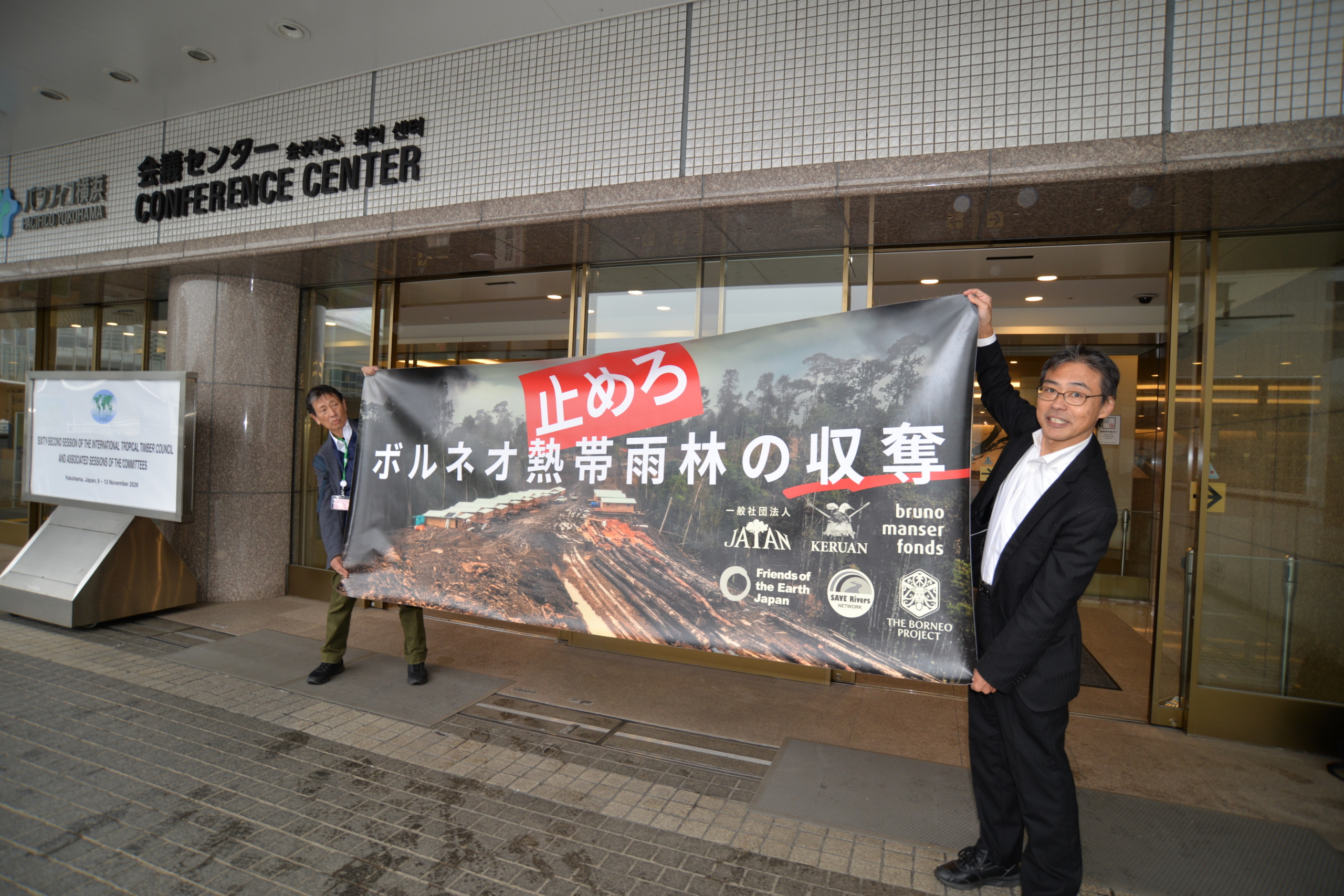
In the upper reaches of the Baram River in Sarawak, Malaysia, the “Upper Baram Forest Area (UBFA) Project,”aimed at forest conservation and led by the International Tropical Timber Organization (ITTO), began in 2023. This was a groundbreaking project launched with the consensus of key stakeholders, including local indigenous communities, Japanese government, Sarawak State Government, Bruno Manser Foundation (BMF), and City of Basel (Switzerland). However, just one year after its launch, the state government stated at an official meeting that “Some stakeholders clearly have different aspirations to those stipulated in the ITTC-approved project document, making it very challenging to continue.” In response to a request from the state government—the implementing entity—the ITTC accepted this in October 2024 as a de facto termination measure.
Borneoland Timber Resources Sdn. Bhd. (BTR), a logging company in Sarawak, began constructing logging roads during the ITTO project period and commenced full-scale logging around the time the project ended. Consequently, forests that indigenous peoples had protected for many years—and which were expected to be conserved through the ITTO project—are now being logged following the project’s termination. The state government granted BTR a logging permit in March 2024. Project stakeholders—including Indigenous communities who have long relied on the forest as the foundation of their livelihoods, culture, and beliefs—have demanded that the state government disclose information regarding the puzzling issuance of this logging permit, but their requests have yet to be heeded.
The threat that logging poses to the last remaining tropical rainforest on Earth is becoming increasingly real. However, the impact does not stop there. Indigenous communities of Penan and Kenyah peoples in the upper Baram River basin are being forced to make an unreasonable choice: whether or not to accept logging by BTR. Currently, BTR’s logging operations are causing serious social friction not only between neighboring communities but also within the same community.
As one of the world’s leading importers (and consumers) of tropical timber, Japan has fulfilled its responsibility by providing substantial funding as the largest host and donor country since International Tropical Timber Organization (ITTO) was established in 1986. The Japanese government (including the Ministry of Foreign Affairs and the Forestry Agency) has also contributed significant funds to individual projects implemented by the ITTO in Sarawak. At the same time, the ties between Japan and Sarawak’s timber industry are extremely long-standing and deep. Looking at recent trends, according to the Sarawak Timber Industry Development Corporation (STIDC) 2024 report, Japan imported timber products worth 1.621 billion ringgit (approximately 63 billion yen). Plywood and wood pellets—a growing sector—are the main items traded. Japan accounted for 82 percent of Sarawak’s plywood exports and approximately 85 percent of its wood pellet exports, totaling 1,112.81 million ringgit (approximately 43.2 billion yen).
Based on the foregoing, we believe that the Japanese government and the ITTO bear a significant responsibility to
account for the logging operations currently underway, and we demand the following:
To the ITTO and the Japanese government:
- The ITTO and the Japanese government shall each conduct an urgent, independent, transparent, and comprehensive investigation into the logging operations taking place in the UBFA project area.
- The ITTO and the Japanese government shall each ensure full transparency and promptly disclose the results of the investigation.
To the Japanese Government:
- Since no evidence has been obtained to rule out the possibility that BTR timber is entering the Japanese market, the Japanese Government must, as a matter of its own responsibility, verify the traceability of timber originating from BTR.
- BTR timber can be considered high-risk timber, as it violates the right to Free, Prior, and Informed Consent (FPIC) guaranteed by the UNDRIP—which Japan has ratified—and is causing conflicts among local residents. Since neither Japan’s Clean Wood Act nor Sarawak’s Forest Ordinance contains provisions regarding such “highrisk timber,” it is not possible to exclude the procurement of timber originating from BTR. Therefore, the requirements of the Clean Wood Act must be immediately reviewed, and risk-based due diligence (DD) must be strengthened. Furthermore, “Sarawak” must be designated as a high-risk region, and businesses must be urged to conduct more cautious and rigorous due diligence.
End
Friends of the Earth Japan (FoE Japan)
Japan Tropical Forest Action Network (JATAN)
Sarawak Campaign Committee (SCC)
Hutan Group
Human rights now
Contants:
Junichi Mishiba (FoE Japan)
Email: mishiba@foejapan.org

