[Press Release] Don’t Chase the Wrong Treasure: at COP31, civil society tells Japan to steer Asia away from gas, not toward it
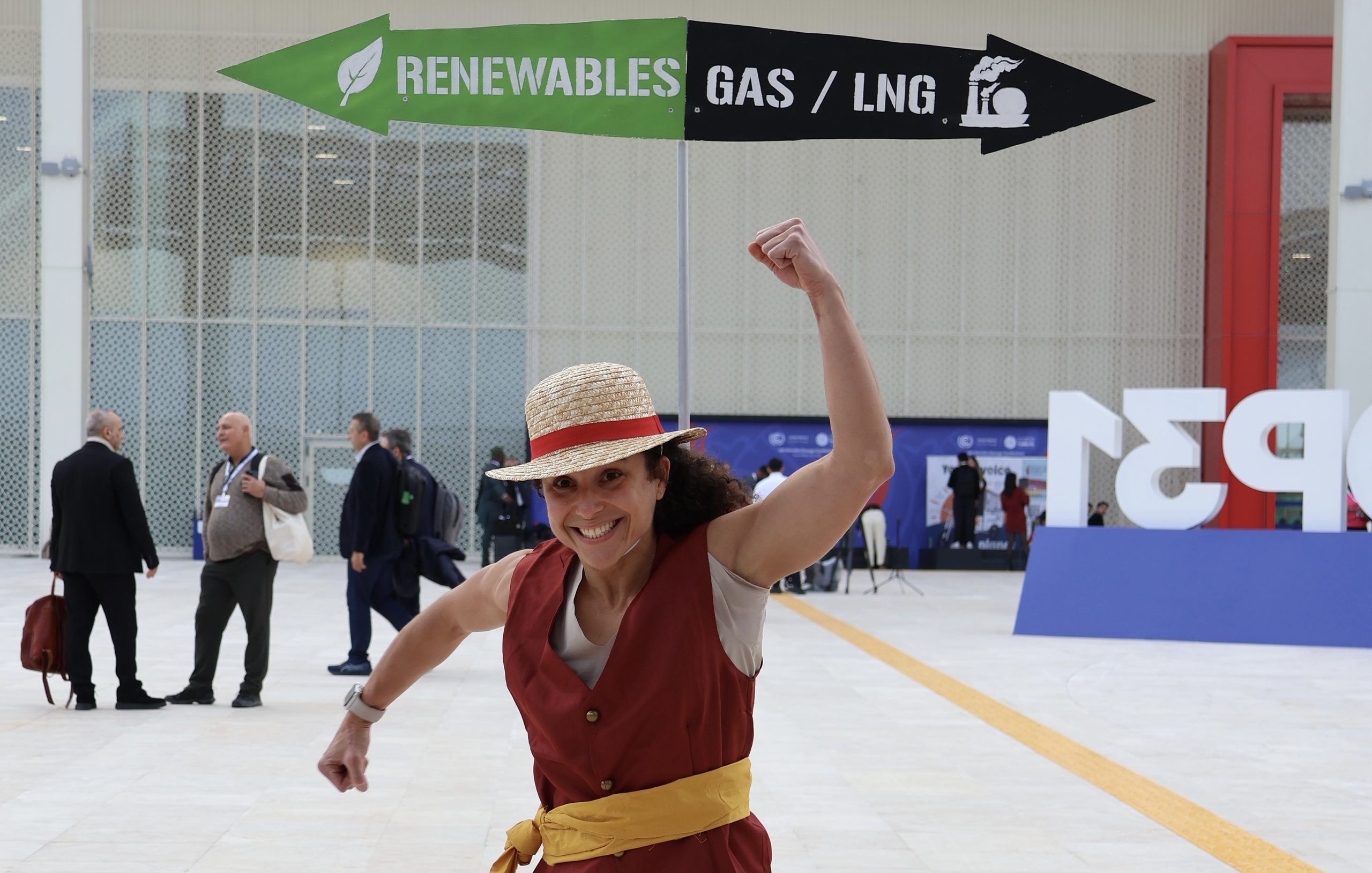
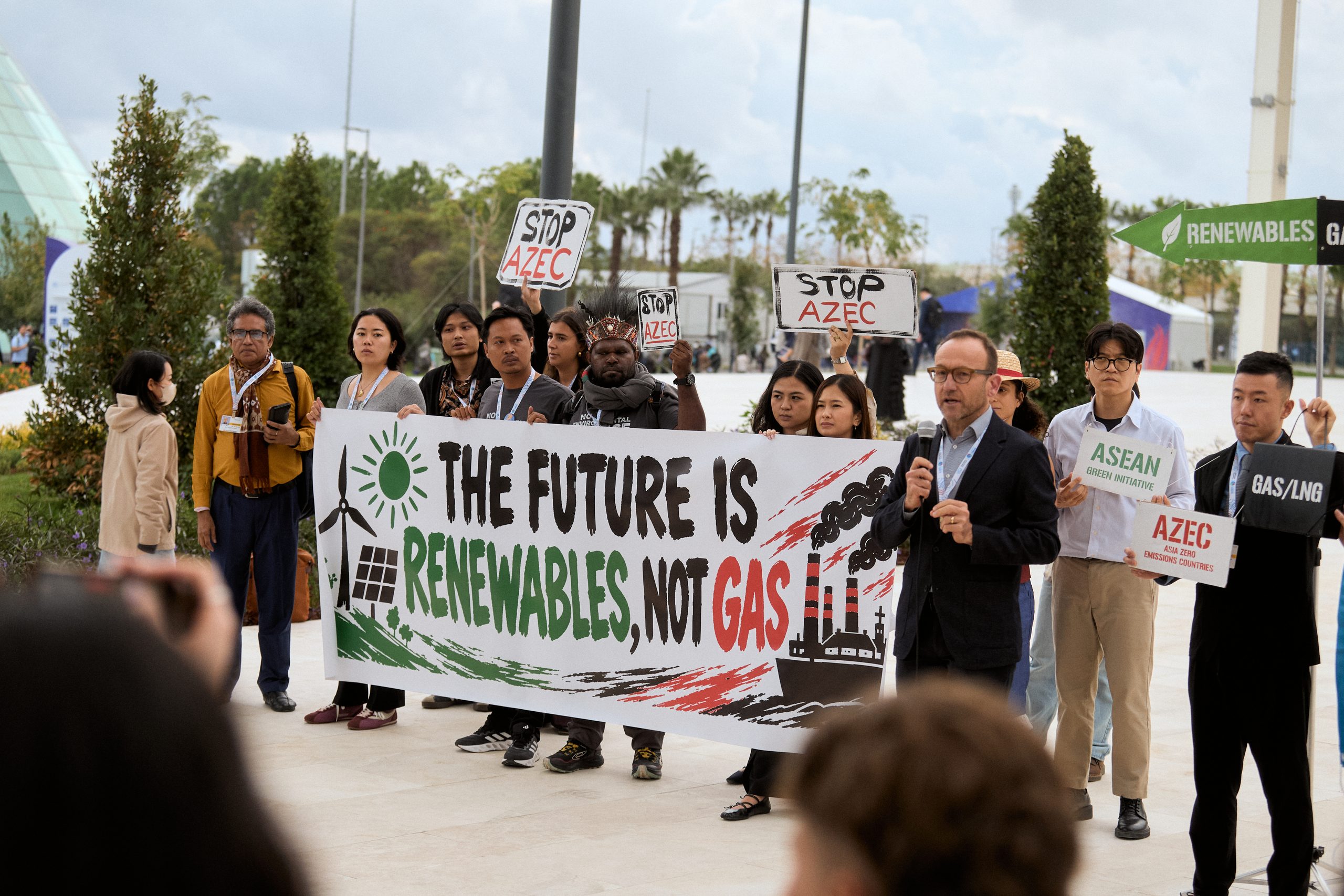
Photo Credit: Bianca Csenki
See the PDF version.
Action Photos will be uploaded here (please credit if suggested).
ONE PIECE-themed action and Asia-wide protests spotlight Japan’s fossil finance, its LNG resale business, and its absence from global efforts to transition away from fossil fuels.
Antalya, Türkiye — November 13, 2026 — Citizens worldwide gathered to demand an immediate end of Japanese financial support for fossil fuels, including through the Asia Zero Emission Community (AZEC) and POWERR Asia. In the performance, a character labelled “AZEC” lured ASEAN toward gas instead of renewables. Luffy, the straw-hatted hero of the hit Japanese manga, then knocked out AZEC’s influence and leads ASEAN back toward renewables, with a banner that read “The Future is Renewables, Not Gas!”
The action kicked off the Asia-wide protests with a collective call to stop Japanese fossil finance, including a protest in Manila with over 1,000 registered participants, as well as actions in Thailand, Australia, multiple cities in Indonesia, Bangladesh, Nepal, India, and Japan.
Under AZEC and POWERR Asia, Japan pushes Asian countries to use more LNG, hydrogen and ammonia co-firing, and CCS — through hundreds of MOUs, financial support, and even technical support for revising their long-term energy policies, into which Japan intentionally inserts those technologies. These expensive fossil-based technologies are false solutions that prolong fossil fuel dependence in a region with huge renewable potential.
These efforts are part of Japan’s broader strategy to keep LNG flowing. Japan is the world’s largest provider of international public finance for fossil fuels, supporting gas projects such as Browse in Australia, where Japan lobbies to influence the country’s energy policy. JBIC and Japan’s megabanks–MUFG, SMBC and Mizuho–are targeting a final investment decision of Papual LNG by December 15, despite 32 financial institutions having already ruled out financing amid serious climate, biodiversity and human rights concerns. Japan claims that it needs new LNG supply to prevent “the neon lights of Tokyo ever going out”, yet it resells more LNG than it imports from Australia, its biggest LNG supplier. At the same time, Japan publicly finances gas-fired power plants and import terminals in Southeast Asia to “create LNG demand” for its surplus LNG.
The consequences are severe. Emissions from the Japan Bank for International Cooperation’s (JBIC) finance reached 236.5 million tonnes of CO2e across Scopes 1, 2, and 3, making JBIC the world’s 28th biggest emitter if it were a country, ahead of the oil-producing state of Qatar. Another severe consequence is the harm to communities on the ground. At the action, speakers from the Philippines, Bangladesh and Indonesia highlighted how Japanese-backed gas expansion endangers marine biodiversity and livelihoods, for example in the Verde Island Passage, a global marine biodiversity hotspot.
While Japan doubles down on gas abroad, it is staying away from the growing global push to move beyond fossil fuels. At COP30, Japan did not back the roadmap to transition away from fossil fuels. In its submission to the COP30 Presidency’s roadmap consultation, Japan argued that an immediate transition is difficult and that a “phased decarbonization approach that introduces transition technologies” is essential, seemingly referring to the same, problematic technologies it is pushing through AZEC.
The action amplified communities’ demands worldwide: end Japanese public support for fossil fuels, stop false solutions, and contribute climate finance for a just transition.
Quotes
Amalen Sathananthar, Asian Coordinator, The Artivist Network
“With the world in desperate need for more climate action, seeing Japan continue pushing gas into Southeast Asia is a big disappointment. It derails our countries from true climate action and hampers our ambitions. We need to hold our leaders accountable and also pressure Japan and their entities to stop this dangerous push in the wrong direction to lock Southeast Asia into gas for decades to come. I don’t want to be an old man and still fighting against gas in my country!”
Gerry Arances, Executive Director,
Center for Energy, Ecology, and Development
“Japan-backed gas and LNG projects and financing in the Philippines have left Filipinos burdened with sky-high electricity prices. Beyond high costs, local communities are left with degraded ecosystems, resulting in the loss of their livelihoods. This reliance on fossil fuels must end. At a time when the Philippines and the broader Southeast Asian region are facing the intensifying impacts of the climate crisis, we must move decisively to accelerate the transition away from fossil fuels.”
Masagus Fathan, GIS Lead,Trend Asia
Indonesian people have met the crimes of Kaido during Wano Arc in the One Piece series. AZEC can bring 156K premature death and 109bn USD health related loss in Indonesia through extending coal plants life according to our Toxic 20 report.Real just transition only delivered from non-debt financing, transparency, accountability, and most importantly, people consent.
Erin Ryan, Senior International Campaigner, Climate Action Network Australia
“Australia is being rightly criticised for approving new coal and gas projects while shepherding COP31 negotiations. But each polluting new project has Japanese finance, diplomatic pressure and demand at its roots. A bilateral relationship built on coal and gas has only worsened household costs and climate impacts in both countries, while generating billions in profit for Japanese gas companies. Australians are getting taken for a ride, and it’s time for the Albanese Government to put their interests first by rejecting Japanese-backed new coal and gas projects, and moving towards cleaner cooperation with Australia’s trading partners.”
Masayoshi Iyoda, Campaigner, 350.org Japan
“After receiving the Fossil of the Day award at COP31 in Antalya after Japanese Prime Minister Sanae Takaichi skipped the Leaders Summit, Japan continues to draw criticism for pouring its efforts into policies that deliver the worst outcomes for our climate. Even after this year’s energy crisis, Japan is doubling down on its fossil fuel dependency and pushing other Asian countries—particularly through the Asia Zero Emission Community (AZEC)—to do the same. Japan is repeating its past mistake: a decade ago, it sought to export its “high-efficiency, low-emission” coal technologies across Asia, a strategy that failed completely from both a climate and an economic perspective. Amid the urgent global call for a just transition from fossil fuels to affordable renewable energy, expanding fossil gas infrastructure serves only as a dangerous distraction along with co-firing of coal and ammonia, CCS/CCUS, and nuclear.”
Angelica Mantikas, Corporate Campaigner, Market Forces
“Thirty-two financial institutions have already ruled out financing Papua LNG. So why haven’t Japan’s biggest banks done the same? MUFG, SMBC, Mizuho and JBIC have a choice to make. They can help bankroll another massive fossil fuel project, threatening the rivers, forests and livelihoods that communities in Papua New Guinea depend on, or they can rule it out. With a final investment decision approaching, MUFG, SMBC, Mizuho and JBIC need to make their position clear. If there is no genuine Free, Prior and Informed Consent of Communities, there should be no financing for Papua LNG.”
Hikmat Soeriatanuwijaya, Senior Partnership and Outreach Officer, Oil Change International
“While the world’s governments gather in Antalya to work out how to move away from fossil fuels, Japan is back home brokering more oil and gas deals through AZEC. Southeast Asia is already facing climate disasters, rising energy costs, and loss of the coasts and ecosystems we depend on. Japan is making every one of these crises worse. It locks our region into LNG, ammonia co-firing and CCS for decades, while our communities carry the cost. Japan must end its finance for fossil fuels and support a just, renewable transition.”
Media contacts
- Ayumi Fukakusa, FoE Japan – fukakusa@foejapan.org, WhatsApp/Signal +81 80 6917 0794
- Hiroki Osada, FoE Japan – osada@foejapan.org, WhatsApp +81 80 2788 8401
- Ari Balle-Bowness, Australian Conservation Foundation – WhatsApp +61 478 808 682
- Andrea Leung, Solutions For Our Climate – andrea.leung@forourclimate.org, WhatsApp +852 9192 9262
- Antony Balmain, Market Forces – antony.balmain@marketforces.org.au, WhatsApp, +61423253477
Organizers: Artivist Network, FoE Japan, SFOC, Australian Conservation Foundation, Oil Change International, 350.org Japan, CAN Australia, Market Forces, and numerous other CSOs

